


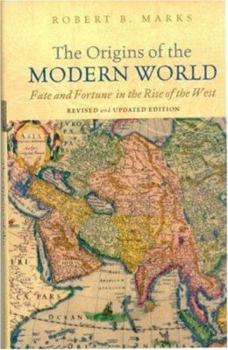
The Origins of the Modern World: Fate and Fortune in the Rise of the West (World Social Change)


Select Format
Select Condition 
Book Overview
How did the modern world get to be the way it is? How did we come to live in a globalized, industrialized, capitalistic set of nation-states? Moving beyond Eurocentric explanations and histories that revolve around the "rise of the West," distinguished historian Robert B. Marks explores the roles of Asia, Africa, and the New World in the global story. He defines the modern world as marked by industry, the nation state, interstate warfare, a large and growing gap between the wealthiest and poorest parts of the world, and an escape from environmental constraints. Bringing the saga to the present, Marks considers how and why the United States emerged as a world power in the 20th century and the sole superpower by the 21st century; the powerful resurgence of Asia; and the vastly changed relationship of humans to the environment.
Format:Hardcover
Language:English
ISBN:074255418X
ISBN13:9780742554184
Release Date:December 2006
Publisher:Rowman & Littlefield Publishers
Length:240 Pages
Weight:1.16 lbs.
Dimensions:9.4" x 1.1" x 6.4"
Customer Reviews
3 ratings
pleasantly surprised
Published by Thriftbooks.com User , 20 years ago
After reading the last review, I was not looking forward to reading this book. As a history major, I've read a lot of really awful and uninsightful stuff, and I figured I was in for 150 pages of an average, West-hating, unbalanced, and bitter view of history. Fortunately, I found that this wasn't at all the case. Marks managed to cover some of the most difficult and emotionally charged material (colonialism, racism, etc.) without injecting hatred or even judgement into his writing. [The Hitler comment mentioned by the other reviewer was taken radically out of context.] Marks' view is really just that all people (not just Europeans, not just Asians) are capable of innovation and power given the right contingent circumstances. He even introduces many creative new ways of looking at old facts. Furthermore, he seems much more aware of the difficulties of historical analyses than others. On several occasions, he discusses the problems that categorization presents for the historian. Unlike countless other academics, he does not pretend that our categories are things in themselves - he acknowledges that a term like, say, "European" is shorthand, rather than some unchanging essence. In short, he does not try to hide the fact that history is created by people, and thus should be subjected to careful scrutiny. Given the enormity of the task he's presented with (summarizing world history in a half inch thick book), he does a fantastic job. The only "complaint" I can muster is that there could have been more coverage of Japan and Austrailia, but this was a judgement call that he made with good reason. This book provides a good framework in which to build a more detailed picture. I wholeheartedly recommend it for college courses or even as a supplement to an AP World History class.
Wonderfully explained!
Published by Thriftbooks.com User , 22 years ago
I took two classes with Dr. Marks. All I have to say is that I think he is absolutely brilliant. I really learned a lot from this book and his classes. He enjoys his profession and clearly knows what he is talking about. I would recommend this book to anyone interested in history.
Bridging the Gap
Published by Thriftbooks.com User , 23 years ago
It often takes 5-10 years or longer for new scholarship to filter down into undergraduate survey textbooks, and this is especially true of the rapidly developing field of world history. Robert Marks' short book is an attempt to bridge this gap. It is a terse synthesis of recent historical revisionism surrounding 'the rise of the west'.Those familiar with the recent scholarship in world history will note that Marks has shamelessly stolen concepts and arguments outlined by historians such as Fernand Braudel, William McNeill, Andre Gunder Frank, Ken Pomeranz, Charles Tilly, Bin Wong, Jim Blaut, Philip Curtin, Janet Abu-Lughod, Immanuel Wallerstein, Dennis Flynn and Arturo Giraldez - and a host of other historians whose works form the foundation of 'the new world history'. This is no doubt the strength of this short 160 page book since there is virtually no other book that summarizes and integrates this scholarship so succinctly at the moment. Indeed, Marks' book works better as an historiographical survey than as a historical narrative, as the subtitle would suggest.While the book is ostensibly written for both students and the educated public, it seems clear that it will be most useful as a text for college courses and perhaps even graduate seminars in world history. It should also find its way onto the bookshelves of teachers of world history survey courses and high school AP World History.A final caveat - be prepared for sticker shock. It is obscenely expensive; even counting the index and preface... an exorbitant price for a paperback book of this length.
Copyright © 2026 Thriftbooks.com Terms of Use
| Privacy Policy | Do Not
Sell/Share My Personal Information | Cookie Policy | Cookie Preferences | Accessibility Statement
ThriftBooks® and the ThriftBooks® logo are registered trademarks of Thrift Books Global, LLC
ThriftBooks® and the ThriftBooks® logo are registered trademarks of Thrift Books Global, LLC
