


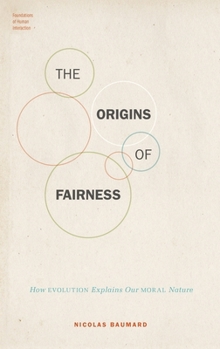
The Origins of Fairness: How Evolution Explains Our Moral Nature
No Customer Reviews

In order to describe the logic of morality, "contractualist" philosophers have studied how individuals behave when they choose to follow their moral intuitions. These individuals, contractualists note, often act as if they have bargained and thus reached an agreement with others about how to distribute the benefits and burdens of mutual cooperation. Using this observation, such philosophers argue that the purpose of morality is to maximize the benefits of human interaction. The resulting "contract" analogy is both insightful and puzzling. On one hand, it captures the pattern of moral intuitions, thus answering questions about human cooperation: why do humans cooperate? Why should the distribution of benefits be proportionate to each person's contribution? Why should the punishment be proportionate to the crime? Why should the rights be proportionate to the duties? On the other hand, the analogy provides a mere as-if explanation for human cooperation, saying that cooperation is "as if" people have passed a contract-but since they didn't, why should it be so?
To evolutionary thinkers, the puzzle of the missing contract is immediately reminiscent of the puzzle of the missing "designer" of life-forms, a puzzle that Darwin's theory of natural selection essentially resolved. Evolutionary and contractualist theory originally intersected at the work of philosophers John Rawls and David Gauthier, who argued that moral judgments are based on a sense of fairness that has been naturally selected.
In this book, Nicolas Baumard further explores the theory that morality was originally an adaptation to the biological market of cooperation, an arena in which individuals competed to be selected for cooperative interactions. In this environment, Baumard suggests, the best strategy was to treat others with impartiality and to share the costs and benefits of cooperation in a fair way, so that those who offered less than others were left out of cooperation while those who offered more were exploited by their partners. It is with this evolutionary approach that Baumard ultimately accounts for the specific structure of human morality.
To evolutionary thinkers, the puzzle of the missing contract is immediately reminiscent of the puzzle of the missing "designer" of life-forms, a puzzle that Darwin's theory of natural selection essentially resolved. Evolutionary and contractualist theory originally intersected at the work of philosophers John Rawls and David Gauthier, who argued that moral judgments are based on a sense of fairness that has been naturally selected.
In this book, Nicolas Baumard further explores the theory that morality was originally an adaptation to the biological market of cooperation, an arena in which individuals competed to be selected for cooperative interactions. In this environment, Baumard suggests, the best strategy was to treat others with impartiality and to share the costs and benefits of cooperation in a fair way, so that those who offered less than others were left out of cooperation while those who offered more were exploited by their partners. It is with this evolutionary approach that Baumard ultimately accounts for the specific structure of human morality.
Format:Hardcover
Language:English
ISBN:0190210222
ISBN13:9780190210229
Release Date:April 2016
Publisher:Oxford University Press
Length:270 Pages
Weight:1.15 lbs.
Dimensions:1.2" x 6.2" x 9.3"
Customer Reviews
0 rating
Copyright © 2026 Thriftbooks.com
Terms of Use | Privacy Policy | Do Not Sell/Share My Personal Information | Cookie Notice | Cookie Preferences | Accessibility Statement
ThriftBooks ® and the ThriftBooks ® logo are registered trademarks of Thrift Books Global, LLC
ThriftBooks ® and the ThriftBooks ® logo are registered trademarks of Thrift Books Global, LLC
