


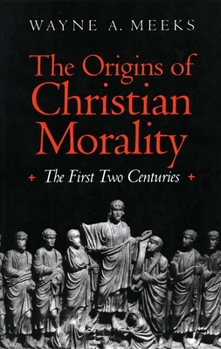
The Origins of Christian Morality: The First Two Centuries

Select Format
Select Condition 
Book Overview
By the time Christianity became a political and cultural force in the Roman Empire, it had come to embody a new moral vision. This wise and eloquent book describes the formative years--from the crucifixion of Jesus to the end of the second century of the common era--when Christian beliefs and practices shaped their unique moral order.
Wayne A. Meeks examines the surviving documents from Christianity's beginnings (some of which became the New Testament) and shows that they are largely concerned with the way converts to the movement should behave. Meeks finds that for these Christians, the formation of morals means the formation of community; the documents are addressed not to individuals but to groups, and they have among their primary aims the maintenance and growth of these groups. Meeks paints a picture of the process of socialization that produced the early forms of Christian morality, discussing many factors that made the Christians feel that they were a single and "chosen" people. He describes, for example, the impact of conversion; the rapid spread of Christian household cult-associations in the cities of the Roman Empire; the language of Christian moral discourse as revealed in letters, testaments, and "moral stories"; the rituals, meetings, and institutionalization of charity; the Christians' feelings about celibacy, sex, and gender roles; and their sense of the end-time and final judgment. In each of these areas Meeks seeks to determine what is distinctive about the Christian viewpoint and what is similar to the moral components of Greco-Roman or Jewish thought.
Wayne A. Meeks examines the surviving documents from Christianity's beginnings (some of which became the New Testament) and shows that they are largely concerned with the way converts to the movement should behave. Meeks finds that for these Christians, the formation of morals means the formation of community; the documents are addressed not to individuals but to groups, and they have among their primary aims the maintenance and growth of these groups. Meeks paints a picture of the process of socialization that produced the early forms of Christian morality, discussing many factors that made the Christians feel that they were a single and "chosen" people. He describes, for example, the impact of conversion; the rapid spread of Christian household cult-associations in the cities of the Roman Empire; the language of Christian moral discourse as revealed in letters, testaments, and "moral stories"; the rituals, meetings, and institutionalization of charity; the Christians' feelings about celibacy, sex, and gender roles; and their sense of the end-time and final judgment. In each of these areas Meeks seeks to determine what is distinctive about the Christian viewpoint and what is similar to the moral components of Greco-Roman or Jewish thought.
Format:Paperback
Language:English
ISBN:0300065132
ISBN13:9780300065138
Release Date:September 1995
Publisher:Yale University Press
Length:285 Pages
Weight:0.93 lbs.
Dimensions:0.8" x 6.1" x 9.2"
Customer Reviews
2 ratings
Why do we do what we do?
Published by Thriftbooks.com User , 22 years ago
Wayne Meeks presented a brilliant work on the development of the earliest Christian communities during the apostolic and post-apostolic period, as Christianity took root in the ancient city setting of the Roman Empire, in his work `The First Urban Christians' (my review will be coming soon!). In this, the follow-up volume, `The Origins of Christian Morality' explores the deepening development of community and identity of these early Christians as they worked to remain a faithful remnant in a sometimes-hostile world. Meeks is the Woolsey Professor of Biblical Studies at Yale University, with a great deal of scholarly experience that he brings to the questions of the origins of Christian morality. In this book, Meeks has presented `an ecology of moral notions'. This is not a guidebook to state in unambiguous terms questions of present-day moral questions. For reasons explained early, Meeks avoids that kind of question because the question can usually be framed by parameters that pre-suppose the answer. Also, Meeks avoids the term `New Testament ethics' for some particular reasons. Firstly, the early church did not have a New Testament -- the collection of writings we have come to accept as the New Testament had not been collected and recognised as a single body of writings during the first, second and third centuries after the time of Christ, the time during which Christian views of morality were being formed. Morality is also discussed, rather than ethics, because ethics tends to be a second-order reflection on morality. This is not what was occurring generally or primarily at this time. In a unique feature, Meeks gives a brief summary, an almost Cliff-notes-lite, of each of the chapters in his Introduction. He traces his development chapter by chapter, highlighting each main point and its connection to the overall theme of the origins of Christian morality as well as the progression through sociology, politics, philosophy, and theology. Meeks admits to being less than systematic in approach, yet this is reflective of the subject. Christian morality did not evolve in a coherent and orderly fashion. It continues to be polyphonic to this day, with varying degrees of acceptance and intolerance by individuals and communities in the name of a 'purer' morality. `Obviously there can be no community and no tradition if everything is permitted ('All things are lawful, but not all things build up'), and therefore there can be no community without some degree of coercion. Yet unity coerced is unstable ('For why is my freedom judged by a conscience not mine?')' Unlike today, early Christianity was primarily a religion of converts. Today, most Christians of most denominations are born into the community of people and of thought. This was untrue in the time of the apostles, and continued to be untrue for several hundred years, even after Christianity became the religion of the establishment. Conversion was usually a social act, something done in public, and som
Feels like a book on mystery religion, not morality
Published by Thriftbooks.com User , 23 years ago
I read this cover to cover a few months ago. It felt like a highly interesting book about the Christian mystery-religion, rather than a study of morality. Don't pass this book by thinking it's about the narrow topic of morality. I'm only somewhat interested in the topic of the origins of Christian morality, but I didn't feel like this book was about morality. Meeks' style of approach is not at all devotional, but rather, is an engaging and straightforward type of scholarship portraying the early mystic form of Christianity including social aspects.
Copyright © 2026 Thriftbooks.com Terms of Use
| Privacy Policy | Do Not
Sell/Share My Personal Information | Cookie Policy | Cookie Preferences | Accessibility Statement
ThriftBooks® and the ThriftBooks® logo are registered trademarks of Thrift Books Global, LLC
ThriftBooks® and the ThriftBooks® logo are registered trademarks of Thrift Books Global, LLC
