


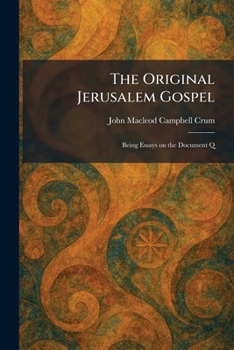
The Original Jerusalem Gospel: Being Essays on the Document Q

"The Original Jerusalem Gospel: Being Essays on the Document Q" is a scholarly investigation into the hypothetical "Q" source-a collection of sayings of Jesus that many biblical scholars believe served as a foundational text for the authors of the Gospels of Matthew and Luke. Written by John Macleod Campbell Crum, these essays delve into the literary and historical mysteries surrounding this lost document, which provides a unique window into the earliest teachings of Christianity.
Crum meticulously examines the evidence for the existence of Q, exploring its probable structure, its theological emphasis, and its origins within the early community in Jerusalem. The work addresses the Synoptic Problem, attempting to untangle the complex relationship between the first three Gospels and their shared sources. By reconstructing the themes and messages of the "Original Jerusalem Gospel," the author offers insights into the linguistic and cultural environment of the first-century Levant.
This collection remains a significant contribution to Biblical criticism and New Testament studies. It is an essential read for theologians, historians, and students of religion interested in the textual evolution of the Christian scriptures and the historical search for the authentic voice of Jesus. Through rigorous analysis, Crum highlights the enduring importance of Document Q in understanding the transition from oral tradition to written gospel.
This work has been selected by scholars as being culturally important, and is part of the knowledge base of civilization as we know it. This work was reproduced from the original artifact, and remains as true to the original work as possible. Therefore, you may see the original copyright references, library stamps (as most of these works have been housed in our most important libraries around the world), and other notations in the work.
This work is in the public domain in the United States of America, and possibly other nations. Within the United States, you may freely copy and distribute this work, as no entity (individual or corporate) has a copyright on the body of the work.
As a reproduction of a historical artifact, this work may contain missing or blurred pages, poor pictures, errant marks, etc. Scholars believe, and we concur, that this work is important enough to be preserved, reproduced, and made generally available to the public. We appreciate your support of the preservation process, and thank you for being an important part of keeping this knowledge alive and relevant.
Customer Reviews
ThriftBooks ® and the ThriftBooks ® logo are registered trademarks of Thrift Books Global, LLC
