


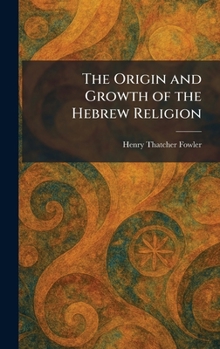
The Origin and Growth of the Hebrew Religion

Select Format
Select Condition 
Book Overview
"The Origin and Growth of the Hebrew Religion" provides a comprehensive historical examination of the development of religious thought and practice among the ancient Israelites. Written by scholar Henry Thatcher Fowler, this work traces the evolution of Hebrew faith from its primitive roots through the formative periods of the judges, the monarchy, and the influential prophetic movements. By analyzing the social, political, and cultural contexts of the ancient Near East, Fowler illustrates how the unique theological perspectives of the Hebrew people emerged and matured over centuries.
The text focuses on the central themes of the Old Testament, examining the shift from tribal traditions to a sophisticated monotheistic system. It highlights the significant contributions of key figures and the impact of historical events, such as the Babylonian exile, on the religious consciousness of the nation. "The Origin and Growth of the Hebrew Religion" serves as a valuable resource for students of biblical history and theology, offering a clear and scholarly perspective on the foundational elements that shaped one of the world's most enduring religious traditions. This study remains an essential guide for understanding the historical continuity and spiritual depth of the Hebrew scriptures.
This work has been selected by scholars as being culturally important, and is part of the knowledge base of civilization as we know it. This work was reproduced from the original artifact, and remains as true to the original work as possible. Therefore, you may see the original copyright references, library stamps (as most of these works have been housed in our most important libraries around the world), and other notations in the work.
This work is in the public domain in the United States of America, and possibly other nations. Within the United States, you may freely copy and distribute this work, as no entity (individual or corporate) has a copyright on the body of the work.
As a reproduction of a historical artifact, this work may contain missing or blurred pages, poor pictures, errant marks, etc. Scholars believe, and we concur, that this work is important enough to be preserved, reproduced, and made generally available to the public. We appreciate your support of the preservation process, and thank you for being an important part of keeping this knowledge alive and relevant.
Customer Reviews
ThriftBooks ® and the ThriftBooks ® logo are registered trademarks of Thrift Books Global, LLC
