


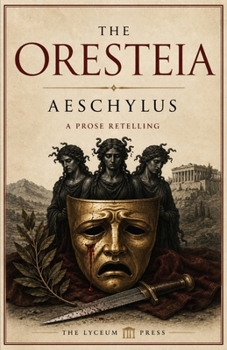
The Oresteia: A Prose Narrative for the Modern Reader

What does justice demand when every act of vengeance creates another victim?
After ten years at Troy, King Agamemnon returns to Argos with victory behind him and danger waiting at home. Before the expedition sailed, he sacrificed his daughter Iphigenia so that his fleet could reach the war. His wife, Clytemnestra, has never forgotten. The welcome she prepares will bring the violence of Troy into the heart of their household.
Their son Orestes inherits a terrible obligation. Apollo commands him to avenge his father, but obedience requires him to kill his mother. With his sister Electra beside him, he returns to a house where grief has become a demand for blood. Whatever he chooses, someone will have a claim against him.
The Furies pursue that claim. Ancient powers charged with avenging the murder of kin, they refuse to accept Apollo's command as an excuse. In Athens, Athena brings the conflict before a court-but a verdict alone may not be enough to end the violence.
This complete translation from the Greek presents all three plays of Aeschylus's Oresteia in clear, modern English dramatic prose: Agamemnon, The Libation Bearers, and The Eumenides.
The dialogue, choruses, and repeated refrains are retained, giving readers the full movement of the trilogy: the king's homecoming, his children's revenge, and the struggle to establish a justice that can hold a community together. Aeschylus gives force to competing claims of duty, kinship, divine authority, and responsibility. Each character can name a wrong that demands an answer.
This edition includes:
Complete translations of all three plays, preserving their dramatic form
A foreword introducing the household conflict and the trilogy's central questions
Cast and setting guides for each play
Explanatory notes on mythology, imagery, and difficult passages
Greek line references for readers who wish to compare passages or consult the notes
An account of the translation's sources and treatment of damaged or uncertain text
For readers discovering Greek tragedy or returning to Aeschylus, this edition offers an accessible way into a drama whose hardest questions remain unsettled: what we owe our families, when obedience becomes wrongdoing, and how the living can answer the dead without repeating their violence.
Customer Reviews
ThriftBooks ® and the ThriftBooks ® logo are registered trademarks of Thrift Books Global, LLC
