


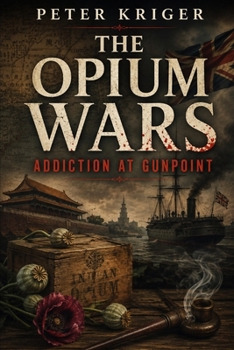
The Opium Wars: Addiction at Gunpoint
No Customer Reviews

Everyone knows the story. A Christian empire sold narcotics to a civilization that did not want them, and when that civilization objected, the empire sent warships. It is the most morally convenient episode in the Western canon, which is exactly why it deserves to be handled with suspicion.
This book takes the case for the defense seriously, and builds it as strongly as the evidence allows. China grew far more opium than it ever imported. The officials enforcing prohibition were often the same men profiting from its failure. The imperial ban was driven at least as much by a hemorrhage of silver as by concern for anyone's lungs. And in a world with no anesthetic, no aspirin, and no cure for dysentery, opium was not a vice at all but the only medicine that reliably worked, which is why the British were soaked in it themselves, dosing their infants with it by the spoonful.
Each of these facts is true. Together they dismantle nearly every sentence of the received account. And then, when the dismantling is finished, something is still standing, and it is worse than the legend it replaced.
Told across three fields rather than two, this is the story of a Bihari peasant compelled to plant poppies on credit, a Cantonese official who wrote a polite letter to Queen Victoria, and a London merchant who arrived at the Foreign Office with a war already drafted. It follows the poison forward through legalization, respectability, and eventual abolition, and then into the present, where the same machinery has been reassembled with different logos and a great deal more paperwork.
Keywords:
Opium Wars, British Empire, China, colonialism, addiction, drug policy, imperialism
This book takes the case for the defense seriously, and builds it as strongly as the evidence allows. China grew far more opium than it ever imported. The officials enforcing prohibition were often the same men profiting from its failure. The imperial ban was driven at least as much by a hemorrhage of silver as by concern for anyone's lungs. And in a world with no anesthetic, no aspirin, and no cure for dysentery, opium was not a vice at all but the only medicine that reliably worked, which is why the British were soaked in it themselves, dosing their infants with it by the spoonful.
Each of these facts is true. Together they dismantle nearly every sentence of the received account. And then, when the dismantling is finished, something is still standing, and it is worse than the legend it replaced.
Told across three fields rather than two, this is the story of a Bihari peasant compelled to plant poppies on credit, a Cantonese official who wrote a polite letter to Queen Victoria, and a London merchant who arrived at the Foreign Office with a war already drafted. It follows the poison forward through legalization, respectability, and eventual abolition, and then into the present, where the same machinery has been reassembled with different logos and a great deal more paperwork.
Keywords:
Opium Wars, British Empire, China, colonialism, addiction, drug policy, imperialism
Format:Paperback
Language:English
ISBN:B0HBMTMCHM
ISBN13:9798189008085
Release Date:July 2026
Publisher:Independently Published
Length:394 Pages
Weight:1.16 lbs.
Dimensions:0.8" x 6.0" x 9.0"
Related Subjects
HistoryCustomer Reviews
0 rating
Copyright © 2026 Thriftbooks.com
Terms of Use | Privacy Policy | Do Not Sell/Share My Personal Information | Cookie Policy | Cookie Preferences | Accessibility Statement
ThriftBooks ® and the ThriftBooks ® logo are registered trademarks of Thrift Books Global, LLC
ThriftBooks ® and the ThriftBooks ® logo are registered trademarks of Thrift Books Global, LLC
