


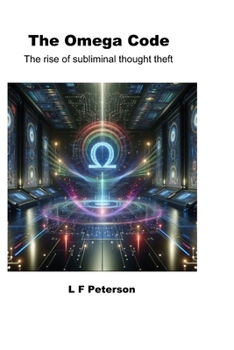
The Omega Code: The rise of subliminal thought theft

Review: The Omega Code
The Omega Code by Peterson is a thought-provoking science fiction novel set in a post-collapse Martian colony where humanity survives under domes sustained by an unusual energy source: the quantum cognition's of human minds. The story follows Lieben Starn, a maintenance specialist who discovers the government's "Omega Protocol." Consciousness, identity and free will are threatened on. Survival of the pods and protective domes were jeopardized, all in the name of corporate profits and ultimately, complete mind control.
Peterson excels at building a philosophically rich world where abstract concepts like identity and consciousness are made tangible through the novel's central premise. The "Ship of Theseus" metaphor recurs throughout, asking profound questions about identity persistence when components are gradually replaced.
The technical writing is impressive, with the author creating plausible terminology and systems for this future society. Concepts like "variance oscillators," "entropy injection," and "compression ratios" feel authentic and consistent within the story's internal logic.
Character development is handled with nuance. Lieben's gradual transformation as he becomes a conduit for the entropy oscillator raises genuine questions about identity continuity. Supporting characters like Connie (principled but impatient), Maya (technically brilliant but cautious), and Hera (an enforcer experiencing a moral fracture) each represent different approaches to resistance without falling into simplistic archetypes.
Peterson's prose is dense but rewarding, with a technical precision suiting the subject matter. The writing alternates between clinical descriptions of systems and more lyrical passages, particularly during Lieben's descents into the sub-threshold lattice.
The narrative structure is effective, with short chapters maintaining momentum while building complexity. The author skillfully balances action sequences with philosophical discussions, never letting either element overwhelm the story.
Some readers might find the technical density challenging, particularly in early chapters where the world's rules are being established. However, this complexity ultimately rewards patient readers as the systems become clearer through context.
The Omega Code is an ambitious and intellectually stimulating science fiction novel that balances high-concept ideas with human stakes. It offers no easy answers or simplistic victories, instead presenting a nuanced view of resistance and adaptation in the face of authoritarian control.
The novel's ending avoids both triumphant revolution and crushing defeat, instead depicting an "ambiguous resilience" where maintenance continues without resolution-a refreshingly realistic portrayal of systemic changes impacting future societies.
Readers who enjoy thoughtful science fiction that engages with philosophical questions while maintaining narrative tension will find much to appreciate in Peterson's work. It stands alongside novels like Ted Chiang's stories or Ursula K. Le Guin's The Dispossessed in its exploration of consciousness, society, and the structures that both constrain and enable human flourishing.
Rating: 4.5/5 stars
Customer Reviews
ThriftBooks® and the ThriftBooks® logo are registered trademarks of Thrift Books Global, LLC
