


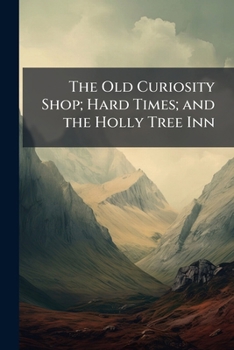
The Old Curiosity Shop; Hard Times; and the Holly Tree Inn

Select Format
Select Condition 
Book Overview
This volume contains three works by Charles Dickens: "The Old Curiosity Shop", "Hard Times", and "The Holly-Tree Inn". "The Old Curiosity Shop" follows the story of Nell Trent and her grandfather as they journey through the English countryside, encountering various characters and hardships. A poignant exploration of innocence and exploitation, the novel showcases Dickens's skill in creating memorable characters and vivid settings.
"Hard Times" is a scathing critique of industrial society and utilitarian philosophy. Set in the fictional Coketown, it examines the dehumanizing effects of relentless industrialization on individuals and communities. Through characters like Thomas Gradgrind and Josiah Bounderby, Dickens exposes the limitations of a purely rational and materialistic worldview.
"The Holly-Tree Inn" is a collection of linked stories told by travelers snowbound at a remote inn. This provides a charming and festive contrast to the other, more serious novels. Together, these works exemplify Dickens's range and enduring appeal, offering readers a glimpse into the social and moral concerns of Victorian England.
This work has been selected by scholars as being culturally important, and is part of the knowledge base of civilization as we know it. This work was reproduced from the original artifact, and remains as true to the original work as possible. Therefore, you will see the original copyright references, library stamps (as most of these works have been housed in our most important libraries around the world), and other notations in the work.
This work is in the public domain in the United States of America, and possibly other nations. Within the United States, you may freely copy and distribute this work, as no entity (individual or corporate) has a copyright on the body of the work.
As a reproduction of a historical artifact, this work may contain missing or blurred pages, poor pictures, errant marks, etc. Scholars believe, and we concur, that this work is important enough to be preserved, reproduced, and made generally available to the public. We appreciate your support of the preservation process, and thank you for being an important part of keeping this knowledge alive and relevant.
Customer Reviews
ThriftBooks® and the ThriftBooks® logo are registered trademarks of Thrift Books Global, LLC
