


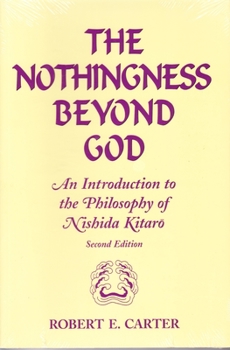
Nothingness Beyond God: An Introduction to the Philosophy of Nishida Kitaro Second Edition

Select Format
Select Condition 
Book Overview
When we hear the term "Japanese philosophy" we think of Zen Buddhism or the Shinto scriptures. Yet one of the great 20th century interpreters of Western philosophy, Nishida Kitaro, lived and wrote in... This description may be from another edition of this product.
Format:Paperback
Language:English
ISBN:1557787611
ISBN13:9781557787613
Release Date:April 1998
Publisher:Paragon House Publishers
Length:256 Pages
Weight:0.90 lbs.
Dimensions:0.6" x 6.0" x 9.0"
Customer Reviews
2 ratings
Much Ado About Nothing
Published by Thriftbooks.com User , 19 years ago
In The Nothingness Beyond God, Robert Carter, from a Western perspective and using a comparative approach, provides a detailed exposition and analysis of the philosophy of Nishida Kitaro, a major Japanese philosopher of the last century. This book represents a significant introduction of Nishida's philosophy to the West, and is considered to be preeminent in the field. Carter pursues the central theme of 'nothingness' by elaborating on a number of Nishida's major concepts, including `pure experience,' the `logic of Basho' (place), `self-contradictory identity,' `action intuition,' and the relationship between religion, morality, values, ethics, and feeling. While extremely important, Nishida's works does tend to be rather difficult. Since this particular book is an academic publication intended primarily for an academic audience, it should come as no surprise that some of the material can be challenging. Nevertheless, while expounding a most difficult subject, the book remains highly readable and is full of compelling insights into the Oriental perspective in general, and Japanese philosophy in particular, insights that are accessible to virtually anyone willing to put forth some effort. As a long-time student of Oriental philosophy, I whole-heartedly recommend Carter's book to those with a similar interest. This is a powerful book which is well written and likely to make a significant contribution to the reader's appreciation of Eastern culture.
Something to Say About Nothing
Published by Thriftbooks.com User , 25 years ago
Carter's "The Nothingness Beyond God" is a beacon that opens up for discovery new possibilities of a meaningful dialogue between Eastern and Western philosophical traditions. Dedicating a chapter to each developmental stage, the book clearly illuminates the evolution of the philosophy of Nishida Kitar . Initiating the inquiry with the concept of pure experience, Carter deftly, yet with eloquent brevity, extricates the essential elements of Nishidan thought from a complex of the philosopher's writings. Carter demonstrates how Nishida never lost sight of his founding concept, pure experience, while he continued to tender increasingly more elucidated refinements that saw the genesis of the Logic of Basho and the concept of Self-Contradictory Identity. The refinement eventually produced a philosophical stance which he called The Dialectical World of "Acting Intuition", and of which this edition offers a substantially expanded exegesis. But Carter does not rest here, he suggests that issues of religion, morality and ethics, in short of value in general, can be, and indeed must be, tied to an understanding of the essential unfolding of the individual, without which, these concepts, lacking a form for expression, would be essentially empty.. In other words, what Carter sees as groundbreaking in Nishida is an insight that offers an ontology that can participate in the resolution of contemporary world issues. Ecology and environmental issues now become deep issues that are inseparable from our own well being. In what has clearly secured itself as a masterpiece of comparative philosophy, its contemporary relevance has additionally advanced the endeavour to bridge the gap between East and West. Yet, one of the more salient features of "The Nothingness Beyond God" is its range of accessibility. It is equally stimulating for the neophyte as well as the seasoned comparativist, in that its accessibility does not come at the expense of scholarly exactness. Well done.
Copyright © 2026 Thriftbooks.com
Terms of Use | Privacy Policy | Do Not Sell/Share My Personal Information | Cookie Policy | Cookie Preferences | Accessibility Statement
ThriftBooks ® and the ThriftBooks ® logo are registered trademarks of Thrift Books Global, LLC
ThriftBooks ® and the ThriftBooks ® logo are registered trademarks of Thrift Books Global, LLC
