


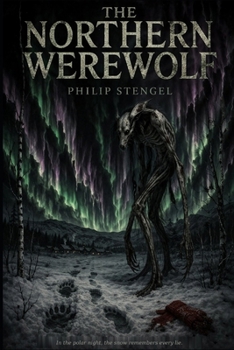
The Northern Werewolf

In the far North, winter is not a season. It is a pressure system that exposes whatever a family has failed to bury. In The Northern Werewolf, scholar Anja Korhonen returns from Helsinki to the isolated village of Karasjoki after her estranged father's letters turn strange and urgent. She tells herself she is coming north as a researcher, to document fading folklore and old Sami winter narratives. What she actually finds is a village already being ruled by something older and more intimate than superstition. Reindeer are found opened and arranged in the snow. Tracks shift from wolf to human and back again. A child is taken from her bed. The aurora above the village no longer looks beautiful. It looks hostile, as if the sky itself has begun listening for lies.
As Anja digs deeper, the novel reveals that the "werewolf" at its center is not a simple monster story at all. It is a blood-bound correction engine born from an atrocity in the Great Hunger, when Karasjoki's founding families survived winter through murder, cannibalism, and a village-wide lie strong enough to warp the land itself. The creature known as the Walking Guilt does not hunt randomly. It moves toward betrayal, hidden shame, and inherited silence, using bloodlines as both target and infrastructure. Anja discovers that her father Reino Korhonen is not merely haunted by this legacy. He is its vessel, the living anchor through which the curse has endured for generations.
By the final movement, The Northern Werewolf shifts from folkloric monster horror into something colder and more devastating. The village is driven toward a reckoning on the Longest Night, where confession might break the old blood oath, but succession proves stronger than truth. What emerges is not a clean victory over the beast, but a transformation of its rule. Anja does not simply survive the curse. She inherits and refines it, becoming the new Warden of Karasjoki under the village's "Warden's Peace," a cleaner, quieter, more intimate regime of terror built not on obvious slaughter, but on perfect exposure and moral surveillance. This is a brutal Northern horror novel about bloodline guilt, inherited order, and the nightmare possibility that the monster can be defeated only by becoming something even more efficient than the monster itself.
Customer Reviews
ThriftBooks ® and the ThriftBooks ® logo are registered trademarks of Thrift Books Global, LLC
