


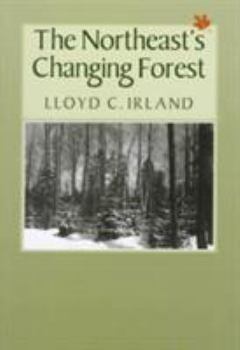
The Northeast's Changing Forest

The Northeast's Changing Forest reviews the history and conditions of the forest in the nine northeastern states. This diverse region stretches from the shores of Lake Erie to Passamaquoddy Bay and from Cape May, New Jersey to northern Maine. The forests range from the dune forest of the New Jersey beaches to subalpine forests in the White Mountains and the Adirondacks. Heavily cleared for agriculture in the nineteenth century, the region's forests have increased in area since 1909 by an amount equal to the entire forest area of Maine, which is 17 million acres.
The region's forests can be thought of as five "forests," each playing a distinct economic role. In the Industrial Forest, the growing and harvesting of industrial wood is the primary use, accompanied by substantial use for hunting, fishing, snowmobiling, and wilderness canoeing. In the Suburban Forest, the general emphasis on "green backdrop" roles belies the importance of casual recreation, firewood cutting, and industrial wood uses. In the Rural Forest of the region's farming and thinly settled rural areas, traditional forest uses continue. In the Recreational Forest, heavily developed areas for skiing, lakeside camps and resorts, and coastal developments set the tone. Finally, in the Wild Forest, preservation of nature is dominant. After generations when few aside from the landowner and technical communities paid the forests much attention, they have now become focal points for policy conflicts. Proposals for large additions to the Adirondack Park's Forever Wild lands, for creating a Maine Woods National Park, and for eliminating all timber harvesting on the region's National Forests are prominent examples. The legislatures of every state in the region deal annually with issues of forest taxation, forest practices regulation, public ownership, and land uses affecting forests. The Northeast's Changing Forest gives readers an historic, geographic, and ecological background for understanding the condition of the forests of the Northeast and the outlook for their future.Format:Hardcover
Language:English
ISBN:067462680X
ISBN13:9780674626805
Release Date:November 1999
Publisher:Harvard University Forest
Length:432 Pages
Weight:0.50 lbs.
Dimensions:1.4" x 6.5" x 9.6"
Customer Reviews
1 rating
A Forest Snapshot
Published by Thriftbooks.com User , 18 years ago
This book provides an interesting statistical overview of the health and productivity of the forest in the Northeast at the turn of the Twenty-First Century. Irland has worked with and studied the forest in this region for several decades. In this book, he updates and extends his classic study, "Wildlands and Woodlots". Irland considers a number of different facets of the forest in the present book, including what he terms, "Town Meeting" (localism in politics and policymaking), the "Eagle's Eye View" (conservation issues), the "Global Commons," (global environmental factors), the "Worm's Eye View" (nutrient cycling), "Economic Interdependence" (urban/rural interdependence), "Cultural Heritage" (wildness and the sense of place), and "Bequest" (heritage and sustainability). He examines each of these facets in detail, providing descriptions of specific forestry challenges. He also discusses how the factors interrelate, how "solutions" may address several problems at once or bring up new conflicts. Irland provides numerous tables summarizing forestry statistics for the region. The book is also amply illustrated with black-and-white photographs and maps. Sources are cited in endnotes. While Springer tries to maintain objectivity in his descriptions of issues affecting the forest, his own view that the forests are currently underutilized does affect his treatment of some topics. He makes the important observation that "The ability of the urbanized Northeast to import its corn from Iowa, its lumber from Canada, its oil from Iraq, and its steel from Japan led its citizens to believe that they had been liberated from dependence on natural resources." Reconnecting with the potential fuel, lumber, and pulp from our forests may be as important as choosing locally grown foods for re-establishing our sense of place and ties to the land. Overall, the book provides an informative and very readable account of the state of the forests in the Northeast as well as suggestions for directions we may need to take in the future for the continued health and sustainability of the forests and the regional economy.
Copyright © 2026 Thriftbooks.com
Terms of Use | Privacy Policy | Do Not Sell/Share My Personal Information | Cookie Policy | Cookie Preferences | Accessibility Statement
ThriftBooks ® and the ThriftBooks ® logo are registered trademarks of Thrift Books Global, LLC
ThriftBooks ® and the ThriftBooks ® logo are registered trademarks of Thrift Books Global, LLC
