
Skip to content
Scan a barcode
Scan
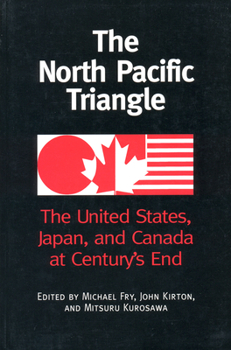
Paperback The North Pacific Triangle: The United States, Japan, and Canada at Century's End Book

ISBN: 0802080650

ISBN13: 9780802080653

The North Pacific Triangle: The United States, Japan, and Canada at Century's End

The emergence of a significant new partnership involving Canada, Japan, and the United States has been largely ignored by students of international relations and Canadian foreign policy. This collection, written by scholars and policymakers from the countries involved, explores the evolving alliance and illustrates its growing strength in a collective global leadership.

The papers examine the three market-oriented democracies in their changing roles toward each other and show how they have moved beyond their separate, special, bilateral relationships into a dynamic three-way engagement. Their intersections in trade, investment, business negotiations, peacekeeping, and environmental affairs are analyzed from a range of perspectives, including political science, management studies, economics, geography, and history. A powerful view unfolds: in the context of a rapidly globalizing economic system, this new triumvirate can only continue to strengthen and flourish, adding its influence to the creation of a new world order.

Recommended

Format: Paperback

Temporarily Unavailable

We receive fewer than 1 copy every 6 months.

Save to List

Customer Reviews

1 rating

A Review by Stephen Heeney, UBC

Review as found in International Journal, Volume LIV No.4 Autumn, 1999. by Stephen HeeneyBy bringing together participants in two networks of scholars specializing in various aspects of the relations between, and among, the United States, Japan and Canada, the editors of this volume have done a service to those seeking to understand the issues. They rightly claim that the book assembles the insights of scholarly specialists in Canada, the Untied States, and Japan across the disciplinary expanses of economics, business, law, diplomacy, political science, and geography. The book has had a long genesis. It began with a conference in Tokyo in 1993(founded in the form of the Canada Japan Research Award), the publication in Japanese in 1995 of some of the articles (that volume won the Canadian Prime Minister's Award for Publishing in Japan), and now the current book which includes revised and updated versions of the original, together with new contributions. The volume is especially helpful in situating Japan within the conjuncture of three friendly countries in the north Pacific, and this it does very well. While the reflection and consciousness-raising provided through this process are evident, the disadvantage is that some of the material and judgments could be dated, especially as the book went to press last year. It is gratifying to note that the contributors have largely avoided this pitfall. However, some contributors on more immediate issues suffer from data no more recent than 1995. More serious is the occasional jarring reference to a `declining' of the United States from which some conclusions as to relative weights of the United States, Japan and Europe are drawn. Decline of the political and economic variety may have been perceived in the United States early in the decade though it has scarcely been a factor since.The presentation of a north Pacific triangle is perhaps overdrawn. The title does beg a glance at J.B. Brebner's classic North Atlantic Triangle (1946) which shows relationships on a scale that is simply not present among the United States, Japan, and Canada. Several articles in the volume are, rightly in my view, not about a triangle at all and treat strictly bilateral issues. There is plenty of room to make constructive contributions to the understanding of the extend and complexity of Japan/USA and USA/Canada relations. To a sometime practitioner of Canada's bilateral relations with Japan, the interesting issue is why people Japan/Canada relations are not richer or more tightly managed than they are. Or, given that they are friendly and profitable, does it matter (as one author asks)? There is an inclination here to give less credit to Canadian leadership than it deserves. Occasionally there are references to the Eurocentrism of prime ministers from Quebec, or to the Liberal Party's enthusiasm for China, as perhaps detracting from a more important relationship with Japan.
Copyright © 2026 Thriftbooks.com Terms of Use | Privacy Policy | Do Not Sell/Share My Personal Information | Cookie Policy | Cookie Preferences | Accessibility Statement
ThriftBooks ® and the ThriftBooks ® logo are registered trademarks of Thrift Books Global, LLC

GoDaddy Verified and Secured