


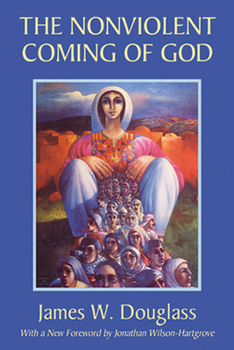
The Nonviolent Coming of God

Select Format
Select Condition 
Book Overview
In this, his most eloquent and far-reaching book, James Douglass explores the haunting parallels between the situation of Jesus and our situation today. Jesus, who lived in anticipation of the impending destruction of Jerusalem by the Romans and suffered from this vision, called urgently for a radical conversion to avert the tragedy. The choice then -- as now -- was between nonviolence and nonexistence. This choice is even more stark in the nuclear age. Whether describing the visions of Gandhi, Martin Luther King, Jr., Archbishop Romero, or the witness of his own community against the White Train carrying warheads across the country, Douglass can discern the sights of a second coming, a nonviolent coming of God. The possibility for a different future depends on a different kind of humanity, renewed and transformed by the nonviolent cross of Christ.
Format:Paperback
Language:English
ISBN:1597526118
ISBN13:9781597526111
Release Date:April 2006
Publisher:Wipf & Stock Publishers
Length:254 Pages
Weight:0.85 lbs.
Dimensions:0.6" x 6.1" x 9.1"
Related Subjects
Christian Books & Bibles Religion Religion & Spirituality Religious Studies TheologyCustomer Reviews
1 rating
Eye-opening, practical insights on living for the kingdom
Published by Thriftbooks.com User , 16 years ago
From the pages of the Gospels, Douglass lays out an understanding of Jesus' mission that makes compelling sense of the challenges before us in a nuclear age of withering life on earth. He beautifully relates conditions in the first-century Levant to those among billions of us who serve (and are served by) a modern-day Rome and among other billions who live on the dregs we leave them. He especially illuminates the contingent nature of Jesus' prophetic message about the downfall of Jerusalem: If the people repent from relying on violent resistance, from following the revolutionary "messiahs" into Roman killing fields, follow the Great Commandment, and learn to love enemies, the kingdom is here now. If not, just like the world in the days of Noah and of Lot, "you will all likewise perish." It is up to them (up to us). What does it mean that the kingdom is at hand, within us, among us, within our power (Lk. 17:21)? Once we read the Gospels clearly, the practicalities and the price of following Jesus are clear. This is an inspiring but humbling book; ultimately, however, it is empowering and energizing. Through correspondence, it relies on some of Walter Wink's early thinking on the Powers; if you are familiar with Wink's books, from "Naming the Powers" to "The Human Being," you will be grateful to find this work, with which they beautifully harmonize. Special thanks to John Wipf for bringing it back into print, among others of Douglass's earlier works on similar themes.
Copyright © 2026 Thriftbooks.com Terms of Use
| Privacy Policy | Do Not
Sell/Share My Personal Information | Cookie Policy | Cookie Preferences | Accessibility Statement
ThriftBooks® and the ThriftBooks® logo are registered trademarks of Thrift Books Global, LLC
ThriftBooks® and the ThriftBooks® logo are registered trademarks of Thrift Books Global, LLC
