


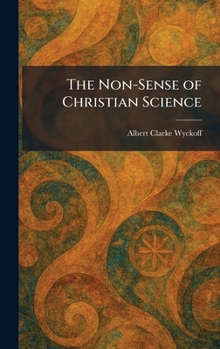
The Non-Sense of Christian Science

"The Non-Sense of Christian Science" presents a critical and analytical evaluation of the religious movement founded by Mary Baker Eddy. Written by Albert Clarke Wyckoff, the work approaches Christian Science through the lenses of both theological orthodoxy and psychological investigation. The author examines the movement's foundational claims, specifically focusing on its teachings regarding the nature of reality, the rejection of physical illness, and its interpretation of biblical scripture.
The book delves into the philosophical and logical structures of Christian Science, aiming to identify internal inconsistencies and what the author characterizes as departures from sound reasoning. By addressing the rapid growth of the movement in the early 20th century, Wyckoff provides a contemporary perspective on the tensions between traditional faith and new religious developments. This work is an essential resource for students of religious history, theology, and the psychology of belief, offering a detailed rebuttal to one of the most significant spiritual movements of its time. "The Non-Sense of Christian Science" remains an influential example of religious apologetics and critical scholarship.
This work has been selected by scholars as being culturally important, and is part of the knowledge base of civilization as we know it. This work was reproduced from the original artifact, and remains as true to the original work as possible. Therefore, you may see the original copyright references, library stamps (as most of these works have been housed in our most important libraries around the world), and other notations in the work.
This work is in the public domain in the United States of America, and possibly other nations. Within the United States, you may freely copy and distribute this work, as no entity (individual or corporate) has a copyright on the body of the work.
As a reproduction of a historical artifact, this work may contain missing or blurred pages, poor pictures, errant marks, etc. Scholars believe, and we concur, that this work is important enough to be preserved, reproduced, and made generally available to the public. We appreciate your support of the preservation process, and thank you for being an important part of keeping this knowledge alive and relevant.
Customer Reviews
ThriftBooks ® and the ThriftBooks ® logo are registered trademarks of Thrift Books Global, LLC
