


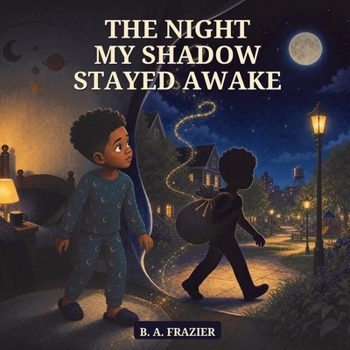
The Night My Shadow Stayed Awake

The Night My Shadow Stayed Awake
Author and creative: B. A. Frazier / Bryan A. Frazier
Imprint: Bright Moon Books
Parent publisher: Darius Blackman Publishing
Series: The Awake Shadow Series, Book 1
Submission operator: Bryan A. Frazier
Status: Owner approved for owner-controlled submission
Book identity and promise
The Night My Shadow Stayed Awake is a 32-page illustrated picture book for children ages four through eight. It combines bedtime fantasy, classroom anxiety, emotional honesty, and gentle humor in a story about a thoughtful seven-year-old Black boy named Amari Wells. Amari wants so badly to avoid mistakes that he begins hiding questions, wrong answers, and worried feelings from the people around him. One night, those hidden worries become too heavy to ignore. His shadow slips away from the bedroom wall, carries the worries into a magical moonlit neighborhood, and leads Amari through a sequence of imaginative challenges. The book's central promise is reassuring but active: courage does not require perfection, and a child can move forward even while the heart is still thumping.
The story should feel warm, mysterious, emotionally precise, and safe for repeat bedtime reading. It is not a lecture about confidence. It is a child-centered adventure in which Amari discovers the meaning through choices, consequences, curiosity, and action. Adults can recognize the social-emotional learning underneath the fantasy, while children can enter the story through the runaway shadow, the glowing streets, the odd objects, and Amari's growing willingness to speak.
Audience and reading context
The primary audience is children ages four to eight, approximately preschool through grade three, with particular relevance for children who worry about being wrong in class, hesitate to raise their hands, replay mistakes at bedtime, or try to appear fine when they are carrying difficult feelings. The book is also designed for parents, caregivers, teachers, counselors, librarians, and read-aloud leaders who want a story that opens conversation without turning the final pages into a lesson plan.
The language must work aloud. Sentences should be clear enough for younger listeners but textured enough to reward older independent readers. Page turns should carry discovery or emotional change. The fantasy should never become frightening in a way that overwhelms the reassurance. Darkness is rendered as deep blue, violet, moonlight, and warm household gold rather than horror. Amari's shadow is strange and independent but never evil. The emotional tension comes from the weight of what Amari has hidden, not from a villain trying to hurt him.
The ideal reading experience allows a child to recognize a private fear, travel through an imaginative night, feel the pressure release, and finish with a believable act of courage the next morning. The final classroom moment matters because Amari does not become perfect. He raises his hand, gives an imperfect answer, and survives the moment. His shadow raises its hand too, showing that the worried part of him has not vanished; it has become something he can carry honestly.
Complete narrative overview
Amari Wells begins the story with a plan to make no mistakes. At school, the plan fails in ordinary ways. He misspells a word. He gives a wrong number. Later, he knows a possible answer but keeps his hand down because he remembers how exposed he felt. None of these events is catastrophic to the classroom, but they are large inside Amari. He carries them home as evidence that speaking up is dangerous.
Customer Reviews
ThriftBooks ® and the ThriftBooks ® logo are registered trademarks of Thrift Books Global, LLC
