


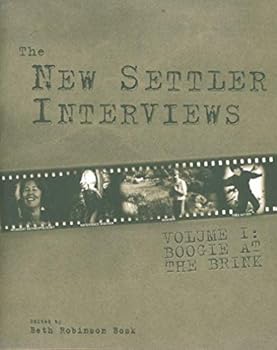
The New Settler Interviews: Boogie on the Brink


Select Format
Select Condition 
Book Overview
From Maine to Arizona and Oregon to the Carolinas, people have come home to the land. They've created original census tracks, new family traditions, and fresh forms of micro-business that combine... This description may be from another edition of this product.
Format:Paperback
Language:English
ISBN:189013239X
ISBN13:9781890132392
Release Date:January 2000
Publisher:Chelsea Green Pub Co
Length:290 Pages
Weight:1.05 lbs.
Dimensions:10.3" x 0.8" x 8.3"
Customer Reviews
3 ratings
Albion Ridge and the Redwoods of Northern California
Published by Thriftbooks.com User , 25 years ago
I love reading the New Settler newspaper from Northern California. These are the stories of the pioneers and activists of Humboldt and Mendocino counties. The backwoods of the Pacific rainforest. Their stories are like the new Foxfire books.--Alex Sydorenko, Chicago, 2001
Living Funky
Published by Thriftbooks.com User , 25 years ago
Here is gathered an elite corps of the Northern California Conscious -- people who really live the day -- and instructions in the art of what anthropologist Jentri Anders calls "living funky." The first volume of Beth Bosk's projected three-volume oral history, The New Settler Interviews: Boogie at the Brink has all the skinny on how to build with cob (mix sand, clay and straw, pat into loaves, knead into house shape, dry in sun), make charcoal or gunpowder from alder, make love 150 feet up in an ancient redwood tree (wear a harness? Or go bare?), test your fertility (use your fingers), or abort a fetus using black and blue cohosh. The New Settler is always good reading, filled with the kind of detailed how-to advice that makes a book feel like a hammer in your hands. Bosk has lived in Mendocino for thirty-one years and has been putting out her bright, insightful Interviews for fifteen; she is our Studs Terkel, the gentle interrogator, not of working class people like Terkel's, but of activists and artisans who do specialized, interesting labor on their own clock. The purest expression of the life Bosk celebrates comes from Mateel, a "value system" codified by certain people living in the watersheds of the Mattole and the Eel Rivers in Humboldt County, California. The Mateelian world view is also expressed as "minority culture that is young, but intact and determined," and as a "class" of people - not working class, or middle class, but "Class K," designating possibly the highest concentration of people in anywhere in America who built unpermitted, unfinished (i.e., "funky") houses with their own hands. Most of the new settlers represented here are pretty clever in one interesting way or another. But Bosk sees a larger -- more conscious -- program: "As fast as authentically aboriginal societies are disappearing, these folks are stripping their own lives of the garb, or garbage (whatever the metaphor) of 20th -century `civilization' and redressing themselves into paraprimitive communities." In such communities, says Jentri Anders, "the best aspects of primitive societies are combined with the best aspects of civilization to create an ecologically sound, naturally oriented culture. The kind of thing Callenbach describes in Ecotopia.... The tribal concept abides, the concept that we are all members of the same tribe." The enraptured, tribal "we" are clearly the "good guys" here (as one forest activist puts it). "We" are the peaceful bravehearts, the neotraditional feminists, the Buddhist Marxists, the swelling ranks of the "conscious." "They" are Pacific Lumber, Maxxam and Charles Hurwitz, the lost souls in cities, most of the working class, and everybody else. The result of all this consciousness can be a little, well, self-conscious. Freeman House, a watershed worker and author of Totem Salmon: Life Lessons From Another Species (Beacon Press) nicely describes the lure of "native culture
great idea, finally a book of very cool interviews!
Published by Thriftbooks.com User , 25 years ago
The New Settler Interviews Vol. 1: Boogie at the Brink edited by Beth Robinson Bosk (Chelsea Green; 2000; 289pps; $22.95) A few years back, a friend gave me a copy of the New Settler, a newspaper zine published in northern California focussing on the pioneers, visionaries and activists involved in creating a new sustainable culture. I was impressed to find out that there were no articles, only lengthy interviews, in-depth, personal explorations of the presented topic(s). Wow! what hard work... to transcribe an interview or two per issue is tedious enough let alone 6-7 per issue. To transcribe tape after tape for a publication that only prints 2500 copies is truly remarkable and exemplifies the commitment Beth Bosk and friends have given to this publishing endeavor. And, she's been doing this for 15 years! This book is Volume 1 of The New Settler Interviews. In this book, we discover interviews with such famous people as Julia Butterfly (in fact, Beth's interview with Julia was the first one of its kind before the mainstream press got a hold of her incredible story). If you want to learn more about what folks are doing in the heart of the logging industry and in the heat of the battle to save the ancient redwood forests as well as green building pioneers (cob, straw), the solar engineering architects, poets, tree living communities, alternative land owning... check this book out. Especially with Beth Bosk as your intelligent guide to these positive futures (she allows the interviewee to go into all sorts of areas that are profound as well as ecstatic), you will not only feel encouraged but it might even inspire us to walk our talk, more and more and more.... Bob Banner
Copyright © 2026 Thriftbooks.com Terms of Use
| Privacy Policy | Do Not
Sell/Share My Personal Information | Cookie Policy | Cookie Preferences | Accessibility Statement
ThriftBooks® and the ThriftBooks® logo are registered trademarks of Thrift Books Global, LLC
ThriftBooks® and the ThriftBooks® logo are registered trademarks of Thrift Books Global, LLC
