


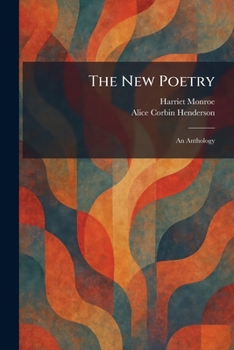
The New Poetry: An Anthology

"The New Poetry: An Anthology" stands as a foundational collection of early 20th-century verse, curated by Harriet Monroe and Alice Corbin Henderson. This seminal work captures the vibrant spirit of the modernist movement, showcasing a departure from Victorian traditions toward more experimental and direct forms of expression. As the editors of the influential Poetry magazine, Monroe and Henderson gathered a diverse array of voices that redefined the landscape of English-language literature.
The anthology features contributions from a wide range of poets who were instrumental in the development of Imagism and other avant-garde styles. Readers will find works that emphasize clarity, rhythm, and the precise use of language, reflecting the cultural shifts and artistic innovations of the era. By bringing together both established figures and emerging talents, "The New Poetry: An Anthology" provides a comprehensive overview of a period marked by profound creative transformation.
This collection serves as an essential resource for those interested in the evolution of modern poetry and the historical context of the modernist revolution. It remains a testament to the power of new ideas and the enduring impact of a generation of writers who sought to make it new.
This work has been selected by scholars as being culturally important, and is part of the knowledge base of civilization as we know it. This work was reproduced from the original artifact, and remains as true to the original work as possible. Therefore, you may see the original copyright references, library stamps (as most of these works have been housed in our most important libraries around the world), and other notations in the work.
This work is in the public domain in the United States of America, and possibly other nations. Within the United States, you may freely copy and distribute this work, as no entity (individual or corporate) has a copyright on the body of the work.
As a reproduction of a historical artifact, this work may contain missing or blurred pages, poor pictures, errant marks, etc. Scholars believe, and we concur, that this work is important enough to be preserved, reproduced, and made generally available to the public. We appreciate your support of the preservation process, and thank you for being an important part of keeping this knowledge alive and relevant.
Customer Reviews
ThriftBooks ® and the ThriftBooks ® logo are registered trademarks of Thrift Books Global, LLC
