


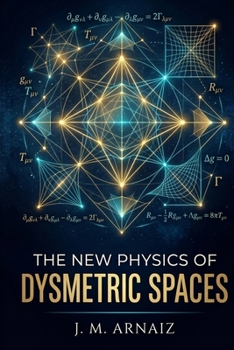
The new Physics of dysmetric spaces
No Customer Reviews

Physics is limited by a fictitious algebra model that fails to account for the fundamental difference between abstract numbers and physical quantities, which are non numerical and diverse. We call this 19th-century misconception the arithmetization of physics, and it essentially consists of the unwarranted assumption that physical quantities possess the structure of an abelian multiplicative group. This error ignores the necessary external generating composition laws that govern the specific relationships between different physical magnitudes, which differ fundamentally from the internal laws of conventional mathematical structures.
Modernizing physics and overcoming its excessive reliance on arithmetic is a task that remained unfinished when, at the end of the 19th century, mathematics underwent a major transformation, replacing the traditional arithmetic systems that had prevailed for centuries with modern or abstract algebra. Without this contribution, the rapid technological progress of recent times would not have been possible, leading to the emergence of such remarkable technologies as information systems, communication networks, computer programming, social media, and artificial intelligence, among many other advancements. Physics was not reformed at that time, and it must do so as soon as possible, following the triumphant example of mathematics, but instead of focusing on abstract numbers, it should focus on the quantities of physical magnitudes, so that the outdated aspects that still persist in it do not hinder the progress of innovations that can only emerge with this modernization.
This text asserts that modernization is possible, necessary, and fruitful, as evidenced by our dyadic algebra of magnitudes, the first of its kind, and its initial achievement: the unexpected epistemological discovery of the invisible dismetric dimension associated with every magnitude. These two concepts are the result of over 30,000 hours of groundbreaking research by the author. The principles that govern them are stated with the utmost clarity, without compromising mathematical coherence or logical rigor. The natural order in which the various concepts, properties, and structures emerged has been preserved, in order to illustrate the creative process and allow the reader to follow the same path of discovery as the author. First, we use dyadic forms to endow magnitudes with their own algebraic structure, and then dysmetry emerges, with its two fundamental physical-mathematical truths: first, the properties of empty space, which is not seen as inert but as an active entity that produces physical effects on its own, characterized by dysmetric tensors; and second, the fundamental law of differential dyadic variation, which proves the original concept that dysmetry is the natural state. Thus, dyadic algebra brings dysmetry to the forefront, revealing the latent richness of physical magnitudes and predicting that their hidden properties are yet to be discovered.
Format:Paperback
Language:English
ISBN:B0CJSNR5ZR
ISBN13:9798862549393
Release Date:September 2023
Publisher:Independently Published
Length:512 Pages
Weight:1.49 lbs.
Dimensions:1.0" x 6.0" x 9.0"
Customer Reviews
0 rating
Copyright © 2026 Thriftbooks.com
Terms of Use | Privacy Policy | Do Not Sell/Share My Personal Information | Cookie Notice | Cookie Preferences | Accessibility Statement
ThriftBooks ® and the ThriftBooks ® logo are registered trademarks of Thrift Books Global, LLC
ThriftBooks ® and the ThriftBooks ® logo are registered trademarks of Thrift Books Global, LLC
