


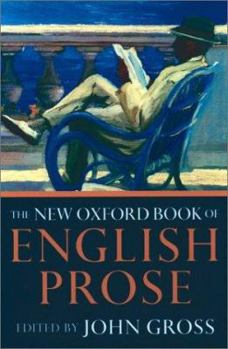
The New Oxford Book of English Prose

Select Format
Select Condition 
Book Overview
Prose, strictly defined, is the ordinary form of spoken or written language. Examples of solid prose are not difficult to come by: a well argued legal judgment, a lucid scientific paper, or a readily grasped set of technical instructions. Inspired prose, however, is a much rarer thing. In The New Oxford Book of English Prose, John Gross has gathered together those rare jewels of the English language that take plain prose to artistic heights.
The pared-down style of Hemingway didnt happen overnight. Beginning with Sir Thomas Malory and ending with Kazuo Ishiguro, this anthology chronologically traces the evolution of prose, which gained confidence and extended its range in the late seventeenth century. It wasnt until the eighteenth century, however, that the ornate style of literary giants like Milton and Donne gave way to prose that was recognizably modern. The material included in this anthology is literary, but literary, as the editor states in the introduction, is not the narrow term that it is often made to beit embraces an enormous range of experience and response. The New Oxford Book of English Prose pays tribute to literatures vibrant diversity by offering glimpses of master craftsmanship from around the globe. Included here are excerpts from writers of such varied backgrounds as Salman Rushdie, Margaret Atwood, Vladimir Nabokov, and Mulk Raj Anand.
From the eloquent political treatises of Burke to the bold narrative strokes of Herman Melville, readers will find that the selections contained within this volume superbly illustrate the expressive powers of prose.
The pared-down style of Hemingway didnt happen overnight. Beginning with Sir Thomas Malory and ending with Kazuo Ishiguro, this anthology chronologically traces the evolution of prose, which gained confidence and extended its range in the late seventeenth century. It wasnt until the eighteenth century, however, that the ornate style of literary giants like Milton and Donne gave way to prose that was recognizably modern. The material included in this anthology is literary, but literary, as the editor states in the introduction, is not the narrow term that it is often made to beit embraces an enormous range of experience and response. The New Oxford Book of English Prose pays tribute to literatures vibrant diversity by offering glimpses of master craftsmanship from around the globe. Included here are excerpts from writers of such varied backgrounds as Salman Rushdie, Margaret Atwood, Vladimir Nabokov, and Mulk Raj Anand.
From the eloquent political treatises of Burke to the bold narrative strokes of Herman Melville, readers will find that the selections contained within this volume superbly illustrate the expressive powers of prose.
Format:Hardcover
Language:English
ISBN:0192142461
ISBN13:9780192142467
Release Date:November 1998
Publisher:Oxford University Press, Incorporated
Length:1054 Pages
Weight:3.40 lbs.
Dimensions:9.8" x 2.3" x 7.0"
Customer Reviews
2 ratings
Five Cheers for Mr. Gross
Published by Thriftbooks.com User , 26 years ago
A good anthologist is like a tour guide of a city you might have thought you knew like the back of your hand who reveals wonderful nooks and crannies and even entire aspects of the most public places that you never knew existed. John Gross is a literary tour guide nonpareil, and the city of English prose he reveals in this successor to old Q's anthology is rife with rich surprises. The Wilde and Newman entries are particularly good. The Flann O'Brien entry might have been better, as could the one for Beerbohm. Nevertheless, even if, unlike our Australian reviewer, you consider D.H. Lawrence a very sorry fellow, you'll still enjoy this immense cornucopia of lively prose gems. Let's hear it for Mr. Gross. Five cheers.
New Oxford Anthology is not so new
Published by Thriftbooks.com User , 27 years ago
The new Oxford Book of English Prose.Eight hundred pages, several hundred different writers, and edited by Oxford don, John Gross... all goes to reinforce old suspicions about great fiction-writing in English.The last editor, Sir Arthur Quiller Couch, is briefly included, a marvellous little piece of advice on style and jargon: `The first virtue, the touchstone of the masculine style is its use of the active verb and the concrete noun. When you write in the active voice, you write as a man... Set even higher store on the concrete noun... The Parables speak only of things which you can touch and see... The Gospel does not, like any young essayist, fear to repeat a word, if the word be good.'This sets out a little of what makes the very best writers in English of true poetic prose. After browsing extensively through authors as various as Shakespeare and Amis, Malory and Clive James, Gibbon and Margaret Drabble, all of whose writings are printed (of course) in the same typeface and in chronological order, so making for more even comparisons, the best can be sorted into three ranks:First without peer, D H Lawrence (whose extracts number third after Dickens and Conrad). His is the clearest most vibrant expressionistic and poetic prose in English writing. His utterly transfixing images (the moon episode in Women in Love, the miner's breakfast in Sons and Lovers) transfigure the natural landscape into charged symbolic dramatic correlatives for emotional states. Truly without parallel. Conrad, writing only twenty years earlier, achieved only slightly less, as did Hardy (Troy's sword-play in Far from Madding Crowd and Tess covered in cuckoospit meeting Angel Clare). George Eliot (early Mill on the Floss) and Emily Bronte in Wuthering Heights (Cathy's madness on seeing Heathcliff's ghost) are outstanding. Most startlingly impressive, Gerard Manley Hopkins, whose letters and diary notes, written fifty years before, detail short word-pictures of extraordinary linguistic intensity. The prose of Dickens (Mr Micawber, and the opening of Great Expectations) can be seen to emerge clearly from Carlyle, Ruskin, Smollet and Gibbon, but is so human and humorous. Jane Austen and Swift's satire sparkle in their different ways. The short samples of Shakespeare's dialogue in prose include little marvels from Hamlet and As You Like It.In the second rank, Dylan Thomas (badly excerpted in the anthology, which should have included A Child's Xmas in Wales, A Day at the Beach, and Bank Holiday Monday instead of a lacklustre chapter of Portrait of the Artist as a Young Dog). Robert Louis Stevenson's Kidnapped and Treasure Island stand out, as does Melville's Moby Dick. Henry James looks stodgy, humourless, pedantic and rather too abstract, not so interested in the sensual world. Orwell's writing is quite different from any of these, yet when he is lyrical and naturalistic (the end of Homage to Catalonia), he is full enough, large enough in
Copyright © 2026 Thriftbooks.com
Terms of Use | Privacy Policy | Do Not Sell/Share My Personal Information | Cookie Policy | Cookie Preferences | Accessibility Statement
ThriftBooks ® and the ThriftBooks ® logo are registered trademarks of Thrift Books Global, LLC
ThriftBooks ® and the ThriftBooks ® logo are registered trademarks of Thrift Books Global, LLC
