


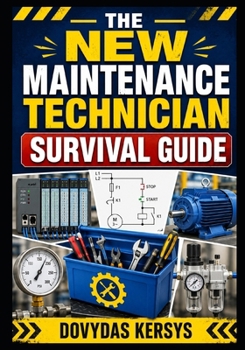
The New Maintenance Technician Survival Guide: A Practical First-Year Guide to Troubleshooting, Electrical Controls, PLCs, Motors, Pneumatics, Hydraul

Starting a job in industrial maintenance can feel overwhelming.
One minute you are tracing a 24 VDC control circuit. The next you are looking at a PLC fault, a stopped motor, a pneumatic cylinder that will not move, or a machine that everyone expects you to fix immediately.
The New Maintenance Technician Survival Guide is a practical first-year field guide designed to help new maintenance technicians become useful, safe, and systematic without pretending to know everything on day one.
Instead of teaching random facts, this book focuses on a repeatable way of thinking:
Make the situation safe → Understand what should happen → Find the first missing condition → Prove the fault → Repair one cause → Verify the result
Inside, you'll learn how to:
Approach breakdowns without panic or random parts swappingWork safely around electrical, pneumatic, hydraulic, and mechanical hazardsLearn unfamiliar machines fasterRead electrical, pneumatic, and hydraulic drawingsUse a multimeter and other diagnostic tools with a clear purposeTroubleshoot 24 VDC control circuitsDiagnose sensors, switches, wiring, and PLC inputsUnderstand PLC outputs, logic, and machine sequencesTroubleshoot motors, contactors, overloads, and VFDsDiagnose pneumatic cylinders, valves, pressure, and air-supply faultsUnderstand common hydraulic problemsSeparate electrical faults from mechanical problemsTroubleshoot industrial network and communication faultsUnderstand machine safety circuits and interlocksDiagnose machines that will not startApproach intermittent faults logicallyStay effective during high-pressure production breakdownsImprove planned maintenance and reliabilityHandle spare parts and replacement components properlyWrite better fault reports and shift handoversIdentify repeat failures and think about root causeWork effectively with operators, engineers, electricians, mechanics, and other tradesBuild useful habits during your first 90 days on the jobThe book also includes practical field exercises, survival rules, diagnostic examples, troubleshooting diagrams, checklists, fault-report templates, and quick-reference material for electrical and pneumatic troubleshooting.
This is not a theory-heavy engineering textbook. It is written for the technician standing beside a stopped machine trying to answer one practical question:
What should happen next, and what is the first thing preventing it?
Whether you are beginning your first industrial maintenance job, moving from mechanical work into electrical troubleshooting, or entering factory automation for the first time, this guide will help you build the habits that make technicians dependable.
You do not need to know everything on day one. You need a method you can trust.
Customer Reviews
ThriftBooks ® and the ThriftBooks ® logo are registered trademarks of Thrift Books Global, LLC
