


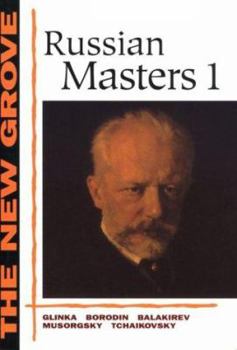
The New Grove Russian Masters I: Glinka, Borodin, Balakirev, Musorgsky, Tchaikovsky


Select Format
Select Condition 
Book Overview
Each has been expanded and updated for book publication and contains a comprehensive work-list, index, and fully revised bibliography, in addition to the definitive view of the subject's life and works. The great traditions of Russian music began in the mid-19th century with Mikhail Glinka--the father figure for the next generations of Russian composers. His direct heirs were 'The Five, ' or 'The Mighty Handful, ' drawn together by Mily Balakirev, the teacher of two leading figures in the group: Alexander Borodin, creator of Prince Igor and quartets of an unmistakably Russian flavor, and Modest Musorgsky, creator of the greatest Russian epics of the lyric stage. Slightly apart from this group because of his more cosmopolitan approach to his art stands the most-loved of all Russian composers, the ever-appealing Tchaikovsky.
Format:Paperback
Language:English
ISBN:0393315851
ISBN13:9780393315851
Release Date:October 1997
Publisher:W. W. Norton & Company
Length:260 Pages
Weight:0.65 lbs.
Dimensions:0.7" x 5.3" x 7.7"
Customer Reviews
1 rating
Well-written synopsis...not for in-depth study
Published by Thriftbooks.com User , 19 years ago
I decided to order this book as part of my growing collection of Russian music literature. In preparing various lecture recitals, an eventual DMA dissertation topic, and out of pure interest, I thought it necessary to an overview of some of the most important Russian composers of the 19th century. This book is essentially a leaner version of complete Grove (which is available in many volumes and online). The composers discussed include Glinka, Borodin, Balakirev, Musorgsky, and Tchaikovsky. Certainly this set of composers represents the development of Russian art as it tried to separate itself from the common European practices at the time. Each composer is discussed by highly-respected experts in the field, including Gerald Abraham, David Brown, Edward Garden, and David Lloyd-Jones. The writing is succinct, albeit a bit brief. The research, although it is quite incredible, is not the most recent in all cases, though the authors do explore many facets of the composers' lives, their compositional styles, their works, and their affect on and influences from other Russian and European composers. Each "essay" is divided into sections, for example, Tchaikovsky (Brown) is split into the following sub-categories: 1840-70; High nationalism, 1870-74; Increasing problems, 1874-7; Marriage: crisis and aftermath, 1877-8; Creative trough, 1878-84; Creative renewal, 1884-90; Last Years, 1891-3; Technique and style. In addition, there is a compiled works' list and bibliography at the end of each section (essay on a specific composer). My only complaint is that the book is indeed so short that is cannot possibly cover all the necessary content to give an in-depth portrayal of these great composers, much less a complete one. There are very few visual musical examples to accompany the written text. Of course, this book is only meant to be a cursory view of the larger subject matter. In that, it succeeds.
Copyright © 2026 Thriftbooks.com Terms of Use
| Privacy Policy | Do Not
Sell/Share My Personal Information | Cookie Policy | Cookie Preferences | Accessibility Statement
ThriftBooks® and the ThriftBooks® logo are registered trademarks of Thrift Books Global, LLC
ThriftBooks® and the ThriftBooks® logo are registered trademarks of Thrift Books Global, LLC
