


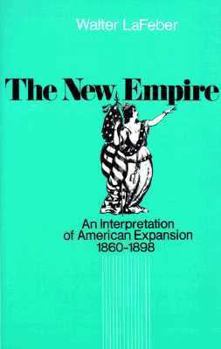
The New Empire: An Interpretation of American Expansion, 1860-1898 (Cornell Paperbacks)


Select Format
Select Condition 
Book Overview
This classic work, by the distinguished historian Walter LaFeber, presents his widely influential argument that economic causes were the primary forces propelling America to world power in the... This description may be from another edition of this product.
Format:Paperback
Language:English
ISBN:0801490480
ISBN13:9780801490484
Release Date:January 1967
Publisher:Cornell Univ Pr
Length:457 Pages
Weight:1.24 lbs.
Dimensions:8.5" x 5.8" x 1.0"
Customer Reviews
4 ratings
Extremely Thorough and Interesting...for the most part.
Published by Thriftbooks.com User , 24 years ago
While the American Revolution and the Civil War are both extremely important periods in the history of the United States, the tendency of many teachers to overemphasize these two eras leads to a peculiar gap in American knowledge, especially when concerning America's period of economic and landed expansion. As Walter LaFeber impresses upon us from the very preface of his book, these formative years are some of the most important in the history of the United States; the opinions and policies shaped through the crises of the late 19th century impacted not only the foreign relations of the time, but created the base from which America's current foreign policy grows and shows many of the reasons for our prominent place upon the global stage. The basic premise of LaFeber's argument is that all roots of American expansion and imperialism in the 19th century are economically based. There are many observable reasons for this economic instability, but the most important argument is that as a result of expanded production and an agricultural and industrial surplus, American companies needed new markets in order to survive. Yet as American converted from intense agricultural cultivation to industrialization, it became increasingly obvious to policymakers and intellectuals alike that due to the hard competition in existing European industrial markets, expansion into unexplored world markets was now essential for America's economic survival. According to LaFeber, the importance of these new foreign markets, especially in Latin America and Asia, becomes the driving force in all foreign policy decisions, forcing Americans, in a sense of self-preservation, from her self-imposed seclusion into participating in global politics. Because this book as a whole is extremely well written and fairly impartial, it is very jarring to note the few times that the author does descend into either idealization or vilification. For instance, when explaining the ultimate reasons for the Spanish-American War, it is interesting to notice however the extreme lengths to which this author does his best to vindicate President William McKinley from the popular opinion of spinelessness. In contrast to the carefully accurate (if to a small degree, pro-American) description of the most of the policymakers involved, many times President McKinley is described in glowing terms that seem out of odds from the rest of the book's candid views. Terms such as "superb" and "uncommon" are used quite frequently to describe both the President and his actions; at every turn LaFeber is trying too hard to convince us of McKinley's political mastery and his decidedly controlling role in the declaration of war upon the Spanish (instead of blaming the whole affair upon McKinley's spinelessness and the pressure of the public and the press), and this becomes bothersome after the first few pages. As the author is a man in a field of men, it is also bit disappointing but
Convincing viewpoints. Essential reading.
Published by Thriftbooks.com User , 25 years ago
Just as revolution had been present in the minds of the Colonists long before 1776 the actual 19th Century expansion that LaFeber examines had begun long before 1898. As early as 1850 but especially after the Civil War American exports climbed dramatically. With the conversion of power from Planters to Industrialists the American industrial economy grew, perpetrating a surplus for which new markets were essential. THE NEW EMPIRE deals not only with the economics of expansion but also with the diplomatic issues that helped usher in a new role for America and its position in global affairs. By the dawn of the new century the United States had acquired possessions reaching half-way around the world and it was these possessions, and their dealings with them, that established the United States as a major world power. Potential readers will find THE NEW EMPIRE to be a very thoroughly researched work that is essential to understanding the factors that were present which influenced American foreign policy as it entered the 20th century. Very thought provoking. Dissipates the common assumption that America merely "took" certain areas. In short, I am satisfied having purchased and read this book. Despite its size it is a fast read but more important lays the groundwork for understanding America's rise as a world power.
A very good book with debatable conclusions
Published by Thriftbooks.com User , 25 years ago
I disagree with much that is in this book but I would not dispute that it is an indispensable work on the 1890s. LaFeber's writing is crisp, his research is vigorous and his conclusions are bold. He is by far the most persuasive and talented member of the economic determinist school.My problems with this book concern its conclusion, where I feel LaFeber's thesis tramples over evidence that the Spanish-American War was triggered more by political events than economic aspirations. His depiction of McKinley seems 2 dimensional and incomplete and his evidence for McKinley's motivations is highly circumstantial. I feel he is far too dismissive of evidence that McKinley was forced into war. The seminal event in the 1890s was (in my view) not so much the product of a rational program of expansion as the outcome of a series of fits and starts, culminating in the destruction of the USS Maine. I would personally recommend Ernest May's Imperial Democracy to complement LaFeber's account of 1898.Nonetheless, this is a real classic. You don't have to agree with the book to find it a valuable contribution to the field.
The book hits the heart of 19th century U.S. foreign policy.
Published by Thriftbooks.com User , 27 years ago
This analysis of the roots of U.S. foreign policy, and its emphasis on expansionism, was written 35 years ago, but remains extremely timely. LaFeber convincingly paints the 1890s as the watershed decade in American history, the decade in which America abandoned forever its isolationist rhetoric and entered the world stage as a power player.But the real insight of the book is that the decade of the '90s flowed inevitably from the internal expansion that drove American history through the 18th century and the first half of the 19th. He points out that by the 1850s, key political figures, especially William Seward, were looking outward, anticipating the need for new markets as an outlet for American agricultural and industrial productivity. LaFeber briefly but sharply etches a portrait of Seward and his influential ideas, and includes excellent analyses of the ideas of other influential men of the day: Frederick Jackson Turner, Alfred Thayer Mahan, Josiah Strong, Brook Adams, and Theodore Roosevelt. Just as impressive is his ability to compare and contrast the expansionist ideas of lesser-known men including secretaries of state William Evarts, Frederick Freylinghuysen, and William G. Blaine.Learned men in all fields sometimes neglect the craft of writing clearly, failing to realize that good writing does not simplify ideas; rather, it illuminates them. Professor LaFeber's recognized this, and his fine writing brings the late 19th century alive. Highly recommended.
Copyright © 2026 Thriftbooks.com Terms of Use
| Privacy Policy | Do Not
Sell/Share My Personal Information | Cookie Policy | Cookie Preferences | Accessibility Statement
ThriftBooks® and the ThriftBooks® logo are registered trademarks of Thrift Books Global, LLC
ThriftBooks® and the ThriftBooks® logo are registered trademarks of Thrift Books Global, LLC
