


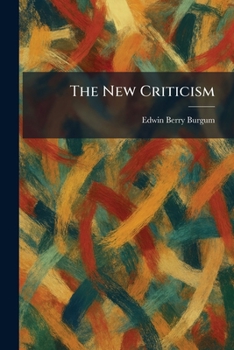
The New Criticism

"The New Criticism", edited by Edwin Berry Burgum, is a seminal anthology that documents the shifting paradigms of literary evaluation during the early 20th century. This collection brings together a series of influential essays that redefine the relationship between the critic, the reader, and the written word. By emphasizing the intrinsic qualities of the text over historical or biographical context, the work explores the formalist approaches that would eventually shape the landscape of modern academic study.
The volume features rigorous intellectual inquiries into the nature of poetry, the function of aesthetics, and the psychological dimensions of artistic reception. Through these diverse perspectives, the contributors seek to establish a more objective and systematic method for analyzing literature, focusing on structure, language, and the autonomy of the work itself. Burgum's curation provides a comprehensive overview of the aesthetic debates that defined an era of profound literary transition.
As a foundational text for understanding literary theory and modernism, "The New Criticism" remains an essential resource for scholars and students. It offers deep insights into the development of critical thought and the evolution of how we interpret the complexities of prose and verse in the modern age.
This work has been selected by scholars as being culturally important, and is part of the knowledge base of civilization as we know it. This work was reproduced from the original artifact, and remains as true to the original work as possible. Therefore, you may see the original copyright references, library stamps (as most of these works have been housed in our most important libraries around the world), and other notations in the work.
This work is in the public domain in the United States of America, and possibly other nations. Within the United States, you may freely copy and distribute this work, as no entity (individual or corporate) has a copyright on the body of the work.
As a reproduction of a historical artifact, this work may contain missing or blurred pages, poor pictures, errant marks, etc. Scholars believe, and we concur, that this work is important enough to be preserved, reproduced, and made generally available to the public. We appreciate your support of the preservation process, and thank you for being an important part of keeping this knowledge alive and relevant.
Customer Reviews
ThriftBooks ® and the ThriftBooks ® logo are registered trademarks of Thrift Books Global, LLC
