


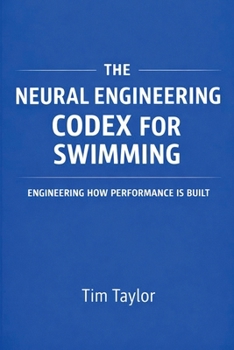
The Neural Engineering Codex for Swimming

Neural Engineering Codex - Swimming presents a science-driven framework for understanding the neurological architecture that underlies competitive swimming performance.
Traditional swim manuals focus on conditioning, stroke mechanics, or mindset cues. This book instead examines how the nervous system organizes rhythm, coordination, timing, and speed execution in water - where ground feedback is absent and neural permission governs output. As a result, performance ceilings are often neurological, not purely physical.
The Codex explains:
Why swimmers "fade" under pressure despite perfect conditioningHow neural regulation affects race executionThe difference between metabolic fatigue and neural inhibitionRhythm integrity and coordination collapseStart and turn neural classificationCNS permission and race-day inhibition protocolsRather than simplistic motivation training, this book offers a technical architecture that identifies where and why speed is lost. Swimming performance is a dynamic interaction between neural signaling, stability perception, and mechanical execution. Coaches and athletes who understand this interaction can diagnose performance breakdowns that traditional models cannot.
Written for high-performance swim coaches, collegiate programs, federations, and elite swimmers, Neural Engineering Codex - Swimming provides a new diagnostic lens for organizing speed in water - one grounded in neural engineering principles and designed for results, not guesswork.
Customer Reviews
ThriftBooks® and the ThriftBooks® logo are registered trademarks of Thrift Books Global, LLC
