


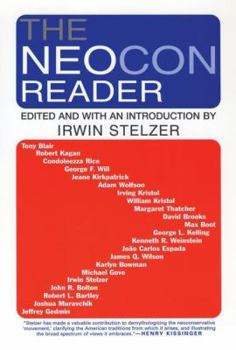
The Neocon Reader

Select Format
Select Condition 
Book Overview
Although neo-conservatism isn't new, the term is widely misapplied, and neo-conservative foreign and domestic policies are little understood. In this anthology of essays written by today's leading neocons, columnists, politicians, and other prominent thinkers give a comprehensive overview of neo-conservative ideology in a bold collection of classic and original essays written especially for this book. Contributors include Max Boot, Lady Margaret Thatcher, George Will, and Condoleezza Rice, among others. Editor Irwin Stelzer attempts to dispel many of the myths built up by foreign and some domestic media that have led many Americans to view neo-conservatism as a radical and cohesive movement. Rather, Stelzer seeks to prove neocons are an eclectic group of intellectuals and politicians who agree on some major policy issues but who pride themselves on their individuality. The Neocon Reader provides a collection of the ideas that are exerting enormous influence on American foreign and defense policy, and serves as an important reminder of how a loose-knit band of intellectuals and politicians thought, wrote, and preached their way into the halls of power.
Format:Paperback
Language:English
ISBN:0802141935
ISBN13:9780802141934
Release Date:November 2004
Publisher:Grove Press
Length:338 Pages
Weight:1.20 lbs.
Dimensions:0.9" x 6.0" x 9.0"
Customer Reviews
1 rating
An informative book
Published by Thriftbooks.com User , 21 years ago
I'm not a conservative. I'm neither paleoconservative nor neoconservative. I'm a liberal. Still, this book tells us who the neoconservatives are and gives us a fair sampling of what they say, and what others say about them. Basically, neoconservatives are former liberals. Most started as Democratic hawks. Some of them were startled by the anti-war Democrats in the 1960s and 1970s, and felt that the anti-war movement went beyond constructive criticism and rejected traditional American attitudes, values, and goals. Others, including many "Scoop Jackson" Democrats, were liberals who wanted to avoid appeasing Soviet tyranny. And some were liberals who were shocked by the treatment of liberal values at the United Nations. Obviously, none of these people had to leave the Democratic Party to maintain their liberal views. But most did. And I was curious to see what views they wound up with. One article is about foot patrols by policemen. But this strikes me as an issue anyone might take either side of, liberal or conservative. Another article discusses pornography and censorship. Well, that certainly might get a different reaction from liberals than from conservatives. Still, both sides surely would draw a line somewhere as to what constitutes obscenity. The only question is where. There is a fascinating article on the deficit. It is pointed out that the deficit only includes money that the government has borrowed and chosen to pay interest on. Social security, which swamps the deficit in size, doesn't count. Neither do America's assets. Even the interest rate is not factored into the size of the deficit in many comparisons. Good points. But what does that have to do with being a liberal or a conservative? There are a couple of articles telling about the history of Britain in its fight against Napoleon, and against Vichy France, and against the Soviets, and even in Kosovo. That is more like it. And while much of this is simply historical, it is clear that George Bush senior and James Baker were anti-interventionist in the former Yugoslavia (clumsily so, if you ask me), while the neocons are interventionists. Well, there is one more issue. Many neocons are Jews. And that leads to why I started reading this book in the first place. A friend of mine told me that the neocons got us into the war with Iraq. And said that "some folks are willing to hurt the United States if they can thereby help Israel." Annoyed, I came up with a, um, jilllike reply: "I'm willing to help Israel if I can thereby help the United States. Unlike some on the Right who are willing to hurt the United States if they can thereby hurt Israel. And some on the Left who are willing to hurt Israel if they can thereby hurt the United States." Of course, all these statements go a little too far. We all know that relatively few Americans want to hurt the United States. Still, we do see some folks imply that the neocons are simply Jews who are more lo
Copyright © 2026 Thriftbooks.com
Terms of Use | Privacy Policy | Do Not Sell/Share My Personal Information | Cookie Policy | Cookie Preferences | Accessibility Statement
ThriftBooks ® and the ThriftBooks ® logo are registered trademarks of Thrift Books Global, LLC
ThriftBooks ® and the ThriftBooks ® logo are registered trademarks of Thrift Books Global, LLC
