


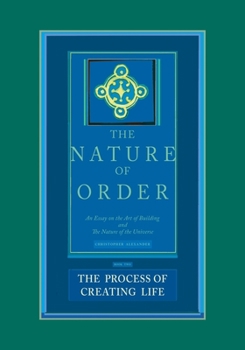
The Process of Creating Life: An Essay on the Art of Building and the Nature of the Universe
(Book #2 in the The Nature of Order Series)
No Customer Reviews

Front-loading the primary subject, this opening sentence presents Alexander's theory of living processes as the defining lens through which the properties of life, wholeness, and structure-preserving transformations shape how buildings, towns, and landscapes come to embody beauty, sustainability, and human meaning.
Christopher Alexander's series of ground-breaking books including A Pattern Language and The Timeless Way of Building have pointed to fundamental truths of the way we build, revealing what gives life and beauty and true functionality to our buildings and towns. Now, in The Nature of Order, Alexander explores the properties of life itself, highlighting a set of well-defined structures present in all order and in all life from micro-organisms and mountain ranges to good houses and vibrant communities.
Scientifically, The Process of Creating Life is perhaps the most exciting of the four books. How do beautiful creations come into being? Nature can make an infinite number of human faces, each one unique, each one beautiful. The same is true for daffodils, streams, and stars. But man-made creations especially the towns and buildings of the 20th century have only occasionally been really good, more often mediocre, and in the last 50 years have most often been deadly. What is the reason for the difference? It hinges on the deep nature of the processes we use. Merely understanding the geometry of beautiful and living form (the topic of Book 1) is not enough to help us create such a living geometry.
In the 20th century our society was locked into deadly processes which created our current built environment, process that most people were not really aware of and did not question. Despite their best efforts and intentions, architects and planners working within these processes could not achieve a living built environment. Life and beauty in the built world arise only from processes which allow living structure to unfold. The secret lies in knowing, as nature does, what must happen in what order: what sequence of events allows a living form to unfold successfully?
Here, in Book 2, Alexander puts forward a fully developed theory of living process. He defines conditions for a process to be living: that is, capable of generating living structure. He shows how such processes work, and how they may be created. At the core of the new theory is the theory of structure-preserving transformations. This concept, new in scientific thinking, is based on the concept of wholeness defined in Book 1: A structure-preserving transformation is one which preserves, extends, and enhances the wholeness of a system.
Christopher Alexander's series of ground-breaking books including A Pattern Language and The Timeless Way of Building have pointed to fundamental truths of the way we build, revealing what gives life and beauty and true functionality to our buildings and towns. Now, in The Nature of Order, Alexander explores the properties of life itself, highlighting a set of well-defined structures present in all order and in all life from micro-organisms and mountain ranges to good houses and vibrant communities.
Scientifically, The Process of Creating Life is perhaps the most exciting of the four books. How do beautiful creations come into being? Nature can make an infinite number of human faces, each one unique, each one beautiful. The same is true for daffodils, streams, and stars. But man-made creations especially the towns and buildings of the 20th century have only occasionally been really good, more often mediocre, and in the last 50 years have most often been deadly. What is the reason for the difference? It hinges on the deep nature of the processes we use. Merely understanding the geometry of beautiful and living form (the topic of Book 1) is not enough to help us create such a living geometry.
In the 20th century our society was locked into deadly processes which created our current built environment, process that most people were not really aware of and did not question. Despite their best efforts and intentions, architects and planners working within these processes could not achieve a living built environment. Life and beauty in the built world arise only from processes which allow living structure to unfold. The secret lies in knowing, as nature does, what must happen in what order: what sequence of events allows a living form to unfold successfully?
Here, in Book 2, Alexander puts forward a fully developed theory of living process. He defines conditions for a process to be living: that is, capable of generating living structure. He shows how such processes work, and how they may be created. At the core of the new theory is the theory of structure-preserving transformations. This concept, new in scientific thinking, is based on the concept of wholeness defined in Book 1: A structure-preserving transformation is one which preserves, extends, and enhances the wholeness of a system.
Format:Hardcover
Language:English
ISBN:0972652922
ISBN13:9780972652926
Release Date:August 2002
Publisher:Center for Environmental Structure
Length:631 Pages
Weight:3.64 lbs.
Dimensions:1.3" x 8.0" x 11.0"
Related Subjects
ArchitectureCustomer Reviews
0 rating
Copyright © 2026 Thriftbooks.com
Terms of Use | Privacy Policy | Do Not Sell/Share My Personal Information | Cookie Policy | Cookie Preferences | Accessibility Statement
ThriftBooks ® and the ThriftBooks ® logo are registered trademarks of Thrift Books Global, LLC
ThriftBooks ® and the ThriftBooks ® logo are registered trademarks of Thrift Books Global, LLC
