


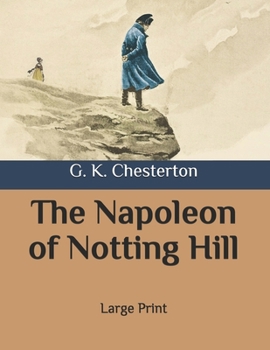
The Napoleon of Notting Hill: Large Print
No Customer Reviews

Very few words are needed to explain why London, a hundred years hence, will be very likeit is now, or rather, since I must slip into a prophetic past, why London, when my storyopens, was very like it was in those enviable days when I was still alive.The reason can be stated in one sentence. The people had absolutely lost faith inrevolutions. All revolutions are doctrinal-such as the French one, or the one thatintroduced Christianity. For it stands to common sense that you cannot upset all existingthings, customs, and compromises, unless you believe in something outside them, something positive and divine. Now, England, during this century, lost all belief in this. Itbelieved in a thing called Evolution. And it said, "All theoretic changes have ended in bloodand ennui. If we change, we must change slowly and safely, as the animals do. Nature'srevolutions are the only successful ones. There has been no conservative reaction in favourof tails."And some things did change. Things that were not much thought of dropped out of sight.Things that had not often happened did not happen at all. Thus, for instance, the actualphysical force ruling the country, the soldiers and police, grew smaller and smaller, and atlast vanished almost to a point. The people combined could have swept the few policemenaway in ten minutes: they did not, because they did not believe it would do them the leastgood. They had lost faith in revolutions.Democracy was dead; for no one minded the governing class governing. England was nowpractically a despotism, but not an hereditary one. Some one in the official class was madeKing. No one cared how: no one cared who. He was merely an universal secretary.In this manner it happened that everything in London was very quiet. That vague andsomewhat depressed reliance upon things happening as they have always happened, whichis with all Londoners a mood, had become an assumed condition. There was really noreason for any man doing anything but the thing he had done the day before.There was therefore no reason whatever why the three young men who had always walkedup to their Government office together should not walk up to it together on this particularwintry and cloudy morning. Everything in that age had become mechanical, andGovernment clerks especially. All those clerks assembled regularly at their posts. Three ofthose clerks always walked into town together. All the neighbourhood knew them: two ofthem were tall and one short. And on this particular morning the short clerk was only a fewseconds late to join the other two as they passed his gate: he could have overtaken them inthree strides; he could have called after them easily. But he did not
Format:Paperback
Language:English
ISBN:B08NF32YL1
ISBN13:9798563761414
Release Date:January 1
Publisher:Independently Published
Length:132 Pages
Weight:0.71 lbs.
Dimensions:0.3" x 8.5" x 11.0"
Customer Reviews
0 rating
Copyright © 2026 Thriftbooks.com Terms of Use
| Privacy Policy | Do Not
Sell/Share My Personal Information | Cookie Policy | Cookie Preferences | Accessibility Statement
ThriftBooks® and the ThriftBooks® logo are registered trademarks of Thrift Books Global, LLC
ThriftBooks® and the ThriftBooks® logo are registered trademarks of Thrift Books Global, LLC
