


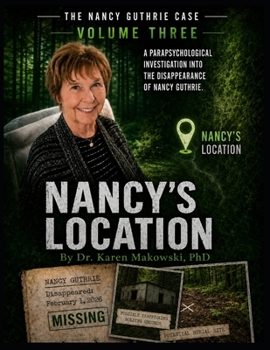
The Nancy Guthrie Case Nancy's Location

My search for Nancy Guthrie did not end with the publication of the first two volumes. If anything, it became more complex.
What began as an effort to locate one missing woman gradually evolved into a broader investigation driven by recurring observations, emerging patterns, and questions that extended far beyond a single disappearance. Throughout countless independent remote-viewing sessions, environmental assessments, geographical analysis, and ongoing investigative review, one fact remained consistent: the observations refused to remain confined to one location or one event.
Rather than producing isolated impressions, the investigation repeatedly returned to similar transportation corridors, environmental characteristics, symbolic imagery, and behavioral themes. Individually, these observations could easily be dismissed. Collectively, however, they formed patterns that deserved careful documentation and continued examination.
Volume Three marks an important transition in this investigation.
Instead of asking only, "Where is Nancy?", the investigation now asks a broader question: "What larger environment might explain Nancy's disappearance?"
This volume documents that evolution. Within these pages, I examine recurring investigative observations developed through real-time remote viewing, terrain analysis, pattern recognition, and independent research. These observations are presented alongside publicly available information and analytical assessments to determine whether recurring consistencies warrant further investigation.
As my investigation progressed, the possibility emerged that Nancy's disappearance might not exist in complete isolation. Repeated observations suggested movement, logistical organization, transportation routes, temporary locations, and behavioral patterns that appeared interconnected. While none of these observations alone establishes fact, together they raise investigative questions that could not simply be ignored.
It is important to understand what this book is and what it is not. This is not a claim of forensic proof, nor does it identify suspects or establish criminal responsibility. The observations documented throughout this volume are investigative hypotheses generated through parapsychological inquiry and evaluated through disciplined analytical review. Like every investigative lead, they require independent corroboration before meaningful conclusions can be reached.
My objective has never been to replace conventional law enforcement or scientific investigation. Rather, it has been to document every recurring observation honestly, preserve the investigative record, and encourage thoughtful examination of patterns that might otherwise remain unnoticed.
Readers will encounter geographical analyses, symbolic impressions, environmental observations, investigative hypotheses, and discussions surrounding organized criminal behavior as it relates to recurring themes observed throughout this investigation. Whether these observations ultimately prove meaningful remains to be determined.
Every investigation requires a willingness to follow credible leads, even when they challenge conventional assumptions. Equally important is the discipline to distinguish between observation, interpretation, and verified fact.
That principle has guided every page of this volume. Whether you approach this work as an investigator, researcher, skeptic, or simply someone seeking a deeper understanding of the Nancy Guthrie investigation, I invite you to examine the material with an open but critical mind as the search for Nancy continues.
.
Customer Reviews
ThriftBooks ® and the ThriftBooks ® logo are registered trademarks of Thrift Books Global, LLC
