
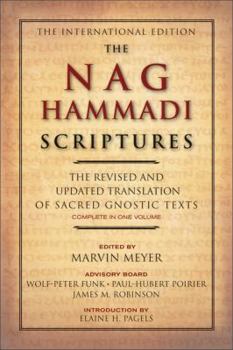
The Nag Hammadi Scriptures, edited by Marvin Meyer, is the most complete, up-to-date, one-volume, English-language edition of the renowned library of Gnostic manuscripts discovered in Egypt in 1945,... This description may be from another edition of this product.
In church, I was taught that Jesus established Christianity and the faith was as homogeneous as it is today. The Nag Hammadi Codices, along with the continuing work of scholars, have completely blown that idea apart. They have illuminated a vicious debate between multiple factions and "a faith" so heterogenous that you have to question how we inherited the cohesive narrative we have today.
For the Scholar and Searcher
Published by Thriftbooks.com User , 20 years ago
For those individuals interested in the evolution of Christian thought, Gnosticism in particular, embarking on a major research project, simply curious about alternative perspectives on the teachings of Jesus Christ, this single volume of fourth-century manuscripts discovered in Egypt in 1945, is absolutely essential. Gnostic thought has always been extremely controversial. Its history and various movements throughout the last millennium are fraught with mystery, censorship, intrigue and bloodshed. As some of the manuscripts pose an entirely different view of the Saviour and His teachings, most traditional Christians dismiss these books entirely. Interestingly, these books have been called "heretical"; taking the word heresy in the literal sense, meaning to take the position in opposition to the orthodoxy of the time, the Nag Hammadi texts are indeed heretical. Throughout theological history, the teachings of the Gnostics, and our knowledge of them as a movement, has really only been provided by the "heresy-hunters", (the first Church Father, Irenaeus of Lyons, and his five book treatise, "Aversus Haereses", translated as, "Against Heresies", is the most noted) giving scholars a seriously one-sided perspective of Gnostic theology, practices and belief. It was only when the Nag Hammadi manuscripts were discovered in 1945 in Upper Egypt, and then painstakingly translated, that we have a greater insight into Gnostic belief, its history and practice. This edition of the Library has been revised and expanded since it was first published in 1978. General editor, James M. Robinson's Introduction to this volume, in my view, is worth the price of the entire text. He provides for the scholar and curious reader a clear and concise history of these gospels, their at times dubious translations, and general explanation of the library as a whole. The Nag Hammadi library also contains manuscripts or treatises other than religious traditions from the Judeo-Christian heritage. For example, "The Discourse on the Eighth and Ninth", is a previously unknown Hermetic text, that presents a fascinating dialogue between the deities Hermes Trismegistus and his son Tat. As Robinson points out, a number of texts contained in the library are debatable in terms of being truly Gnostic in nature, depending on the individual interpreter, and how they define Gnosticism. Personally, I'll leave that debate to the scholars, however, the text themselves make captivating reading. Many hours have been spent reading the various manuscripts contained in this volume. It has taken a tremendous amount of energy and concentration on my part to gain an understanding of the spiritual message(s) that some of these texts provide. This is not a quick read, but a long process of study that for me, will continue for years to come. Having said that, this library is an absolute must as a reference, for any student of theology, Christian history, archaeology and antiquity in general. It is we
ThriftBooks sells millions of used books at the lowest everyday prices. We personally assess every book's quality and offer rare, out-of-print treasures. We deliver the joy of reading in recyclable packaging with free standard shipping on US orders over $15. ThriftBooks.com. Read more. Spend less.

