
Skip to content
Scan a barcode
Scan
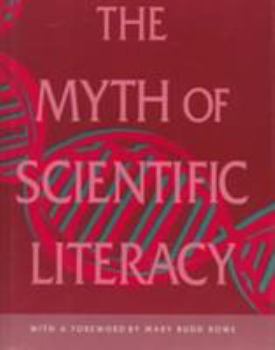
Hardcover The Myth of Scientific Literacy Book

ISBN: 0813521963

ISBN13: 9780813521961

The Myth of Scientific Literacy

Why do we make every schoolchild and college student take science? Does every American really need to be scientifically literate? In this provocative book, Morris Shamos, a physicist and science educator of very broad experience, argues that universal scientific literacy is a futile goal, and urges a critical review of the purpose of general education in science. Shamos argues that a meaningful scientific literacy cannot be achieved in the first place, and the attempt is a misuse of human resources on a grand scale. He is skeptical about forecasts of critical shortfalls in scientific manpower and about the motives behind crash programs to get more young people into the science pipeline. Finally, he is convinced that, as presently taught, the vast majority of students come out of science classes with neither an intellectual grasp nor a pragmatic appreciation of science.

Shamos advocates instead a practical science education curriculum that grants the impossibility of every American learning enough science to make independent judgments about major scientific issues. Rather than giving children the heavy diet of scientific terms and facts they now get, he would emphasize: an appreciation of science as an ongoing cultural enterprise; an awareness of technology s impact on one's personal health, safety, and surroundings; and the need to use experts wisely in resolving science/society issues.

Whether you loved or hated your science classes, you will find Morris Shamos s arguments about the future of science education required reading. Teachers, parents, scientists, science educators, school administrators, legislators, and science and human resources policy analysts will be especially interested in this book.

Recommended

Format: Hardcover

Condition: Very Good

$9.89
Save $25.06!
List Price $34.95
Almost Gone, Only 1 Left!
Save to List

Customer Reviews

3 ratings

Scientific Literacy vs. Scientific Appreciation

It is an idea that has been prevalent for nearly 100 years: in order to consider an education successful, students need to have a basic "scientific literacy." Society depends on the average citizen being able to understand the main ideas in physics, chemistry, biology, and earth science. If we do not give all students scientific literacy of this kind, not only will they be unable to participate in scientifically-laden public debates, but America might lose its place as the industrial leader in science. These ideas are all subjected to a careful and exacting microscope in Morris Shamos's book, Scientific Literacy, and each of them is found wanting. Does the average citizen need to understand science to participate in public discussions of science? That would be like saying that to participate in a debate about the behavior of the current Senate, one must have detailed knowledge of the Constitution's eligibility requirements of the senate. Knowing the ins and outs of climatology will not help the average citizen talk about global warming because (a) such knowledge is more detailed than the average citizen has time/patience and (b) most argument about global warming has more to do with moral/political stances than scientific ones (the latter being done by experts, not the general public). But will foregoing hope of universal scientific literacy mean that less students will go into science? Perhaps, but that is primarily due to market factors, rather than educational ones. Students', and curriculum designers,' decisions are usually made based on "where the money is." If the money is not in science - and it is not! - students will not go there, but go into business, law, etc. It would be strange, argues the author, to attempt 'steering' students towards a profession that is not lucrative, and once it is lucrative, students would likely go there on their own accord. The main thrust of this book, though, is on the first point. The idea that students must have an understanding of science in order to be participating citizens is - while not wholly a myth - an overblown mantra. Most debates hinging on the details of science are conducted by those who have the training to understand the minutiae (just like debates involving the details of history are conducted by historians, not the lay public). At those times where the general public DOES talk science, it is generally in the context of discussing the MORAL or SOCIAL implications of a scientific action, rather than the details of the scientific act itself. Ironically, this can be seen by the obviously irked reviewer below, who takes the authors suggestion that we might "leave the science to the experts" is exactly the mentality that led to society's general support for/indifference to eugenics. Of course, this PROVES the author's point: the issue of whether to practice eugenics is not an issue that demands a detailed understanding of genetidcs or evolution, but is a MORAL issue. Contra the reviewer'

An important book for educators

Although everybody complains about the decline of public education and lack of science literacy, it is worthwhile to actually ask, if the reasons for complaining are valid. Science literacy and popularizing of science are not the same thing. Shamos claims that true scientific literacy as proposed by John Dewey's 'scientific habits of the mind' cannot be realized simply by reading and writing. If science literacy, however, means a simple awareness of science as part of our culture, prospects of achieving science literacy are much better. Shamos clarifies the purpose of science education, examines the history and meaning of scientific literacy and explains the reason for failure of achieving the goal, if the goal is for every citizen to be literate in science. His book includes a well written chapter about nature of science (chapter 3). He explains why the practice of science does and has not carried over very well into science education. Science literacy requires that we understand the following: how to obtain information, how to classify facts, and how to draw logical conclusions. The latter is where the real problem resides. We can always come to a 'right' conclusion based on 'reasoning'. The conclusions, although logically derived, are wrong if the premises are wrong or the observations inaccurate. If we lack the method, i.e., the means to distinguish correct from incorrect premises, reasoning does not help at all. Everything can be rationalized, but is it scientific? Science literacy, for example, means to be able to explain why Darwin's words (e.g. the theory of evolution) for a biologist have a different quality and logical structure than the Word of God (e.g. the Bible, the Koran, the Thora) for a believer. The distinction of method touches at the core of the problem -- science literacy does not mean that everybody becomes a scientist, but to know what science is about and what it is not about.

A honest, good and important book

Contrary to what one might think, this book does NOT make the argument for "leaving it up to the experts". Quite the contrary, it ecourages science educators to stop teaching science "because" people "need" to know basic scientific principles (it may be difficult to accept this, but Shamos gives loads of evidence of why it is an empty goal). The book does by no means discourage the teaching of science. It argues for a CHANGE in the way science is thaught, and in the reasons behind the way science is thaught. Its main argument is that science must be taught because of its aesthetic value, because that's the most realistic way to get good, effective and, above all, honest, science teaching.
Copyright © 2026 Thriftbooks.com Terms of Use | Privacy Policy | Do Not Sell/Share My Personal Information | Cookie Policy | Cookie Preferences | Accessibility Statement
ThriftBooks ® and the ThriftBooks ® logo are registered trademarks of Thrift Books Global, LLC

GoDaddy Verified and Secured