


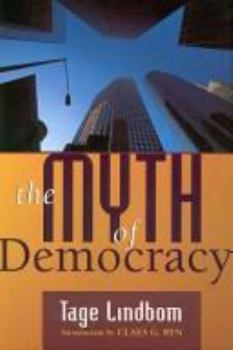
The Myth of Democracy


No Synopsis Available.
Format:Paperback
Language:English
ISBN:0802840647
ISBN13:9780802840646
Release Date:January 1996
Publisher:Eerdmans Pub Co
Length:130 Pages
Weight:0.45 lbs.
Dimensions:9.3" x 0.3" x 6.3"
Customer Reviews
4 ratings
Democracy, tis the "devil's government..."
Published by Thriftbooks.com User , 21 years ago
~The Myth of Democracy~ is brusque, but has a resounding kick in its cultural critique of modern man and the sacrosanct ideology of democracy. There is an enormous gulf between democratic rhetoric and tangible reality. Sinful man yearns for absolute freedom free from shackles of Christian morality and contradictorily longs for security from the state. This seemingly contradictory "libertarian socialism" animates the creed of the messianic state. Lindbom's book discusses the debacle of self-governing man who seeks to trump the sovereignty of God with his own "kingdom of man." Democracy was in the words of founding father Benjamin Rush, "the devil's government..." The brisk book is basically subdivided into three essays: the first chapter corresponds to the title of the book, the second is entitled the Ideology of Socialism and the last chapter is deemed Lucifer. Lindbom brings in classical philosophy into examination, discussing Aristotle, Plato, Augustine's City of God and City of Man and William Ockham. He examines the influence of democratic demigods like Rousseau, Marx, and existential reactionaries like Heidegger. The first chapter the Myth of Democracy bluntly asks "Who will rule, God or man?" This is the continuing inquiry that reverberates throughout the text. "The perennial question is always whether we humans are to understand our presence on this earth as a vice-regency or trusteeship under the mandate of heaven and the divine commandments, or whether we must strive to emancipate ourselves from any higher dominion, with human supremacy as our ultimate aim." The conflict finds it's origin in the fall of man. Lindbom proceeds with analysis of civil society, democratic ideology, and political developments onward from the French Revolution, the Enlightenment, the Romanticism of Rousseau and the emergence of Marxism and secularism. "What is truth?" The question Pilate posed to Christ rings with an aura of relativism and doubt as to whether there is such a thing as truth. Democratic man holds that the truth is whatever is popular, whatever works for man, and that truth is inherently relative and subjective. The second chapter The Ideology of Socialism chronicles the alienation of man with the assent of industrialization, commercialization, the technocrat managerial state, and mass society. Moreover, it dwells on the elusive promise of absolute freedom through that miracle socialism. Socialists in their critique of capitalism, visualize and welcome the atomization of man into a cog in the wheel. They believe it owes to the centralization of the state and corporate structures, which they welcome since it hastens the means by which the proletariat can seize the apparatus which enslaves them. The socialist's elusive search for absolute freedom sees a future heaven on earth if only man would break himself from the bonds of the old order and attain self-realization. Contrary to Marxist assertions, the root of modern man's alienation owes not to
Brilliant Elucidation of Democracy's Luciferian Rebellion.
Published by Thriftbooks.com User , 21 years ago
Tage Lindbom was born in 1909 in Sweden and studied at Stockholm University. He was one of many intellectuals and architects of Sweden's welfare state (his Ph.D. was on unions and labor relations). Involved with liberal politics much of his life, he began to question secular democracy, publishing several books in Swedish on the incompatibility between secular democracy and traditional religion. His _Myth of Democracy_ is actually three essays, "The Myth of Democracy," "The Ideology of Socialism," and "Lucifer." They basically outline components of the great drama of this world: man's rebellion against God."The Myth of Democracy" defines what "democracy" actually means. It comes from the Greek _demos_, "the people" which sometimes meant the common mass of the populace. Lindbom discusses how "the rule of the people" developed as a myth, enshrouded by its own pseudo-mystique, from the various intellectual fashions that tended to subvert Christian orthodoxy. He goes back as far as medieval nominalism as set forth in the writings of William of Occam. The tendency of nominalist thought was that external reality was composed of many individual parts (_multiversum_), which did not assimilate them into a macrocosmic whole, which was the earlier disposition of orthodox Christian philosophy. In this section Lindbom focuses his attention on two prominent intellectuals who appear to give a totally subjective, humanistic worldview the most "transcendent" and "mythical" justification: Jean Jacques Rousseau and Martin Heidegger. Rousseau developed his concept of government of society as a "social contract" between the rulers and ruled. The government was supposed to embody the people as a whole and conform itself to the people's desires. However, the term "people" may not be the most appropriate because it does not accommodate any who might be opposed to the social contract set forth by the majority. If there are any that do not follow Rousseau's "general will" of the people, they need to be ostracized, isolated, or even eliminated. Rousseau believed that better education (propaganda) would illuminate the people to combat oppressive structures, and also hoped humanity, as a whole, would recover Paradise, a primeval idyllic state of social harmony and happiness. Heidegger, writing in the twentieth century, actually absolutized the mere fact that humans exist in his tome _Being and Time_ and perceive the world around them in different ways. With this system of philosophy there can be no absolute truth, no overarching authority because human experience is all and every individual perceives reality differently. Therefore what is best for the majority is to be elevated to the status of man's highest goal, not metaphysical belief which cannot be proved on any physical, empirical scale."The Ideology of Socialism" examines the presuppositions of Marx and how socialism originated during the Industrial Revolution. Industrialism, as Marx correctly pointed
Good diagnosis, bad philosophy
Published by Thriftbooks.com User , 24 years ago
Tage Lindbom's "The Myth of Democracy" is actually a sreies of three essays on the conditions of the modern, secularist mind, as expressed in the fundamental ideas of modern politics. As such, it is an excellent diagnosis of the spiritual and philosophical roots of our civilization's nihilist crisis. Where it begins to fall down is in it's unthinking acceptance of the shallow legerdemain by which we reached this point. For example, much is written here of "equality", and of the process by which that word came to evolve in meaning from a notion of the equality before the moral law of all men because all men where descended from Adam and had a common Creator, to a political slogan as in the French Revolution, to the current radical egalitarianism that enforces politically correct orthodoxy in all walks of life and which seeks to eliminate all differences between persons in the name of an imaginary "emancipation", in which everyone will be "free" of nothing but their own selves. That is an accurate description of the adventures the idea of "equality" has gone through, but it is not philosophically respectable. It invovles a series of sophistries and fallacies that would make any honest thinker wince in pain, most notably the continual changing of the meaning of "equality". Lindbom *never* seeks to demonstrate the illegitimacy of this development, or any of the others. He treats the perversions of the original ideas of freedom, equality, etc. as if they were logically legitimate deductions. This is the book's greatest flaw; for all it's polemical force, it is insufficently critical about the pedegree the ideas it opposes have dishonestly claimed for themselves. That is probably the reason for the curiously vague alternative worldview that is occasionally displayed by the author, who appears to hold to some kind of De-Christ-ized Christianity. Once all of that is understood, the book can be evaluated for it's true worth. It is a scathing and accurate portrayal of the perversities of the secularist mind, but it is not a complete critique of all of their pretensions because it does not show them *as perversities* but as the natural developments of certain ideas buried deep in Western thought. That is it's limitation: it throws out the genuine with the false, and so leaves the author with almost nothing to offer anyone who pays heed to him and rejects modernity. As such, it is valuable as a polemic but not as an apology.
You've Gotta Serve Somebody
Published by Thriftbooks.com User , 25 years ago
Bob Dylan, in his "Christian phase" wrote that no matter who we think we are we are all "gonna have ta' serve somebody". He was right. Dr. Lindbom's book is a working out of that premise in the political context. Since virtually every question of consequence is ultimately religious, Lindbom's observation that the democratic notion of a "self-governing humanity" is mythological shouldn't be surprising. But I think most people who read The Myth of Democracy will find their most cherished myths very fundamentally challenged, perhaps as never before. What can be most disconcerting to the unprepared reader is Lindbom's demonstation that all political choices occur in tension between the divine and the demonic. It doesn't get more real than that! An excellent, though abbreviated read.
Copyright © 2026 Thriftbooks.com Terms of Use
| Privacy Policy | Do Not
Sell/Share My Personal Information | Cookie Policy | Cookie Preferences | Accessibility Statement
ThriftBooks® and the ThriftBooks® logo are registered trademarks of Thrift Books Global, LLC
ThriftBooks® and the ThriftBooks® logo are registered trademarks of Thrift Books Global, LLC
