


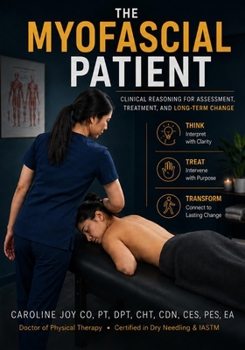
The Myofascial Patient: Clinical Reasoning for Trigger Points, Soft Tissue Pain, and Movement Dysfunction

A tender point can be clinically meaningful without being the whole diagnosis.
The Myofascial Patient is an advanced guide for physical therapists and rehabilitation professionals who want to use hands-on care, physical agents, and exercise without allowing any technique to replace reasoning.
Rather than treating every "knot" as a local tissue problem, Caroline Joy Co shows how to interpret myofascial findings within the patient's history, symptom behavior, irritability, differential diagnosis, load tolerance, nervous-system sensitivity, recovery, goals, and participation.
Readers learn how to:
- Distinguish dominant, secondary, compensatory, protective, sensitized, and incidental myofascial findings
- Select a meaningful comparable sign and use immediate and delayed re-testing
- Match treatment intensity to irritability and response
- Choose among manual compression, positional strategies, dry needling, IASTM, cupping, shockwave, photobiomodulation, taping, heat, stretching, and other adjuncts
- Integrate symptom relief with movement, loading, education, and self-management
- Recognize when regional symptoms require broader screening, referral, or a revised working explanation
- Document clinical decisions with appropriate safety, consent, and scope boundaries
Regional chapters address cervical, shoulder-girdle, thoracic and rib, lumbar, hip and pelvic, lower-extremity, and upper-extremity presentations. Seven author-created composite cases follow reasoning across multiple visits, including contradiction, reclassification, progression, recurrence, and return to meaningful activity.
This is not a trigger point atlas or a protocol book. It is a practical clinical reasoning text for clinicians who want to treat the point when it matters, look beyond it when necessary, and use every intervention as part of a larger path toward function, confidence, and independence.
Part of The Clinical Reasoning in Physical Therapy Series.
Customer Reviews
ThriftBooks ® and the ThriftBooks ® logo are registered trademarks of Thrift Books Global, LLC
