


The Multilingual Internet

Select Format
Select Condition 
Book Overview
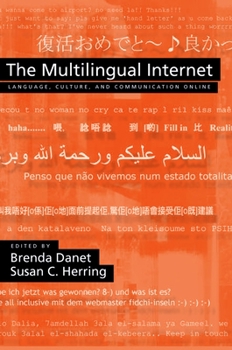
Two thirds of global internet users are non-English speakers. Despite this, most scholarly literature on the internet and computer-mediated-communication (CMC) focuses exclusively on English. This is the first book devoted to analyzing internet related CMC in languages other than English. The volume collects 18 new articles on facets of language and internet use, all of which revolve around several central topics: writing systems, the structure and features of local languages and how they affect internet use, code switching between multiple languages, gender issues, public policy issues, and so on.
Format:Paperback
Language:English
ISBN:0195304802
ISBN13:9780195304800
Release Date:June 2007
Publisher:Oxford University Press, USA
Length:464 Pages
Weight:1.50 lbs.
Dimensions:1.2" x 6.2" x 9.1"
Customer Reviews
1 rating
The Multilingual Internet
Published by Thriftbooks.com User , 18 years ago
The Multilingual Internet This book edited by Brenda Danet and Susan C. Herring is the joint effort of more than ten different authors. This book gathers some of the problems that people from different cultures and languages encounter in the internet. It's is divided into five parts: The first part is about the writing systems and the internet; the second is about linguistic discourse features of the computer mediated communication; the third part is about gender and culture; the fourth is about language choice and code switching; and the fifth part is about language diversity. Part I. Writing Systems and the Internet The first part deals with the problem of languages that are not based on the Roman alphabet. The examples presented are from the Arabic golf, Taiwan, Greece, and French, although, the problem with French is a different one. The problem with French is the neography, the unconventional spelling of the language in CMC (computer mediated communication). In the other cases they use a Romanized version of their own language. In Greece, this phenomenon is called Greeklish in which the Greek phonemics is represented in the Roman alphabet. This problem is due to the fact that the software does not support Arabic, Chinese, or Greek alphabets, however, many of these languages have supporting software but they are difficult to use. In the case of Taiwan it takes four steps to write a single kanji (Chinese character). Greeklish is viewed in three different perspectives. The first one is that is viewed as a threat to the Greek language stated by the Academy of Athens and it's not well founded. The second one views Greeklish as a molding to the new internet era, as something positive; and the third one worries that by the facts that the internet does not accept minority languages, these would eventually disappear. Each of these perspectives have their own followers that debate intensively over this issue. Part II. Linguistic and Discourse: Features of Computer Mediated Communication This part focuses on how people communicate via CMC. These features include the use of informal writing such as all small caps, emoticons, the use punctuation, shortening, etc. These were studied in Japan, Hong Kong, and Cataluña. In Japan, the use of kaomoji (the Japanese equivalent of emoticons) it's very popular for expressing human emotions that cannot be type in. Ex. ( ^_^ ). The same thing happens in Hong Kong, but they are not kaomoji's, they are emoticons in the sense that they are not as elaborated as in Japan, for example ^_^. Also in Hong Kong appears the use of numbers as shortening for words as "99" for "night, night." The other feature such as shortening, punctuation appears on both these cultures. Cataluña's case is different. It is rarely spoken on CMC. Native speakers prefer to use Spanish because Franco prohibited the use in public. Catalan speakers got used to the fact that they couldn't speak it in public spaces, so if they are going to beg
Copyright © 2026 Thriftbooks.com Terms of Use
| Privacy Policy | Do Not
Sell/Share My Personal Information | Cookie Policy | Cookie Preferences | Accessibility Statement
ThriftBooks® and the ThriftBooks® logo are registered trademarks of Thrift Books Global, LLC
ThriftBooks® and the ThriftBooks® logo are registered trademarks of Thrift Books Global, LLC
