


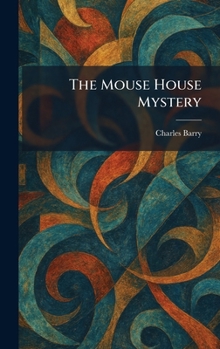
The Mouse House Mystery

"The Mouls Houyse Mystery" is a classic Golden Age detective novel that introduces one of the genre's most steady and intelligent investigators, Superintendent Gilmartin. Set in the mid-1920s, the narrative centers on a perplexing crime occurring within the walls of a private residence, where the quiet facade of provincial life is shattered by an unexpected death. As Gilmartin arrives to spearhead the investigation, he finds himself confronted with a tangled web of aliases, missed opportunities, and a cast of characters whose secrets are as old as the house itself.
The work is a masterclass in the traditional British whodunit, focusing on the meticulous gathering of evidence and the psychological tension between the detective and the suspects. Charles Barry crafts a plot that rewards the attentive reader, blending the procedural details of Scotland Yard with the atmospheric suspense characteristic of early twentieth-century mystery fiction. "The Mouls Houyse Mystery" explores themes of deception and social morality, providing a sophisticated puzzle that challenges the intellect. This novel serves as a foundational entry in the Gilmartin series, showcasing the methodical deduction and persistent inquiry that defined the era's approach to crime and justice.
This work has been selected by scholars as being culturally important, and is part of the knowledge base of civilization as we know it. This work was reproduced from the original artifact, and remains as true to the original work as possible. Therefore, you may see the original copyright references, library stamps (as most of these works have been housed in our most important libraries around the world), and other notations in the work.
This work is in the public domain in the United States of America, and possibly other nations. Within the United States, you may freely copy and distribute this work, as no entity (individual or corporate) has a copyright on the body of the work.
As a reproduction of a historical artifact, this work may contain missing or blurred pages, poor pictures, errant marks, etc. Scholars believe, and we concur, that this work is important enough to be preserved, reproduced, and made generally available to the public. We appreciate your support of the preservation process, and thank you for being an important part of keeping this knowledge alive and relevant.
Customer Reviews
ThriftBooks ® and the ThriftBooks ® logo are registered trademarks of Thrift Books Global, LLC
