


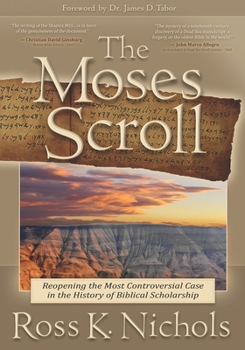
The Moses Scroll

Select Format
Select Condition 
Book Overview
In 1883, Jerusalem antiquities dealer Moses Wilhelm Shapira presented a set of sixteen blackened leather strips written in ancient Hebrew script. The text resembled the Book of Deuteronomy, yet with striking differences. It was said to have been discovered around 1865 in a cave east of the Dead Sea, still bearing traces of linen and a black pitch-like coating-details now familiar from the Dead Sea Scrolls.
The manuscript's narrative moved from Horeb to the plains of Moab, containing a distinctive version of the Ten Words (Commandments)-including one unknown in any other ancient witness-followed by blessings and curses that correspond directly to them, but none of Deuteronomy's later law code (chapters 12-26).
Dismissed as a forgery and forgotten after Shapira's death, the case has reemerged since the discovery of the Dead Sea Scrolls, leading scholars to ask anew: Were the critics wrong?
In The Moses Scroll, Ross K. Nichols retraces the manuscript's 19th-century journey from Jerusalem to Leipzig, Berlin, and London, and then reconstructs the lost text itself, presenting the complete English translation, commentary, and Hebrew reconstruction based on contemporary transcriptions made by those who examined the original strips.
Praised by scholars and reviewers alike:
"A sea change in Shapira studies... a thrill to read-part detective saga and mystery-but solid historical documentation." - James D. Tabor
"No one in the late 19th century could have faked such a complex work... Nichols is now a leading authority on Shapira's discovery." - James H. Charlesworth "A fascinating account of the dramatic story that unfolded in 1883... calls for a re-examination of the case." - Matthieu Richelle, Semitica "Semi-academic, semi-theological... asks, 'What did Moses write?'" - Jonathan Klawans, Dead Sea DiscoveriesThe Moses Scroll invites readers to reopen the most controversial case in the history of biblical scholarship-and decide for themselves.
Customer Reviews
ThriftBooks® and the ThriftBooks® logo are registered trademarks of Thrift Books Global, LLC
