


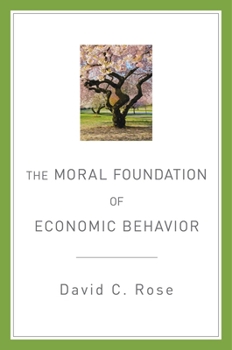
The Moral Foundation of Economic Behavior
No Customer Reviews

Select Format
Select Condition 
Book Overview
This book explains why moral beliefs can and likely do play an important role in the development and operation of market economies. It provides new arguments for why it is important that people genuinely trust others-even those whom they know don't particularly care about them-because in key circumstances institutions are incapable of combating opportunism. It then identifies specific characteristics that moral beliefs must have for the people who possess them to be regarded as trustworthy. When such moral beliefs are held with sufficient conviction by a sufficiently high proportion of the population, a high trust society emerges that supports maximum cooperation and creativity while permitting honest competition at the same time. Such moral beliefs are not tied to any particular religion and have nothing to do with moral earnestness or the set of moral values-what matters is how they affect the way people think about morality. Such moral beliefs are based on abstract ideas that must be learned so they are matters of culture, not genes, and are therefore able to explain differences in economic performance across societies.
Format:Hardcover
Language:English
ISBN:0199781745
ISBN13:9780199781744
Release Date:November 2011
Publisher:Academic
Length:288 Pages
Weight:1.25 lbs.
Dimensions:0.9" x 6.1" x 9.3"
Customer Reviews
0 rating
Copyright © 2026 Thriftbooks.com Terms of Use
| Privacy Policy | Do Not
Sell/Share My Personal Information | Cookie Policy | Cookie Preferences | Accessibility Statement
ThriftBooks® and the ThriftBooks® logo are registered trademarks of Thrift Books Global, LLC
ThriftBooks® and the ThriftBooks® logo are registered trademarks of Thrift Books Global, LLC
