


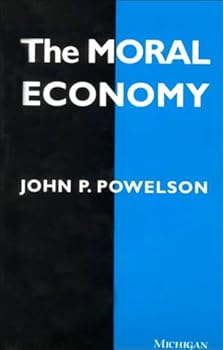
The Moral Economy


When all the momentous current changes in technology and social structure have run their course, we will have created a new world society. Will this society--the total complex of who we are and how we behave--resolve our major economic and social problems? This is the question that John P. Powelson addresses in his provocative new book,The Moral Economy. In his discussion of worldwide problems--including poverty, the environment, population growth, ethnic bias, welfare, social security, and health care--Powelson proposes that solutions to social problems are best sought in a greater balance of power among social groups. He explains how to design institutional structures, like government, education, and religion, that will permit conflict to be resolved peacefully and fairly. He also shows how a moral economy--a balance between interventionism and libertarianism--and economic prosperity are mutually reinforcing. The Moral Economyproposes a desirable world that is historically possible, if certain trends of the past millennium are continued into the next, and if world power becomes more diffuse. As we enter the twenty-first century, it looks to the horizon to suggest what a distant future might bring. "[A] coherent and stunning scenario for the future of humankind. . . . a message for all epochs." --J. D. Von Pischke John P. Powelson is Professor of Economics Emeritus, University of Colorado.
Format:Hardcover
Language:English
ISBN:0472109251
ISBN13:9780472109258
Release Date:January 1998
Publisher:Univ of Michigan Pr
Length:282 Pages
Weight:1.54 lbs.
Dimensions:9.3" x 1.3" x 6.3"
Customer Reviews
1 rating
an excellent look into our economy
Published by Thriftbooks.com User , 25 years ago
"In a moral economy, with today's technology," Powelson begins his book, "no one should be poor." Because Powelson wanted to know why most of the world's people were nonetheless poor, he began about a quarter century ago "to read voraciously in histories all over the world" (p. ix). In 1994 the culmination of his reading, reflection, and analysis was published as Centuries of Economic Endeavor: Parallel Paths in Japan and Europe and Their Contrast with the Third World (Ann Arbor: University of Michigan Press). In The Moral Economy, he now attempts to describe the world of the future on the assumption that the most enduring trends observed in the past will continue. It is an optimistic book, because the trends he perceives can lead eventually to a world in which moral behavior will become routine in the sphere of economic activity, as people find it in their own interest to behave morally. Economic and political power will be diffused so that no person or group, including the government, is able to dominate others. Those who wish to contravene the rules will be disciplined by the market. "The moral economy," Powelson writes, "captures the benefits of technological invention through classic liberalism while using sidewise checks and balances to prevent environmental damage, ethnic and gender bias, and distorted distributions of wealth. . . . In the moral economy, governments facilitate but rarely mandate" (p. 19)...Balance of power is the key to the moral economy, and the book abounds with suggestions about how the power of some to dominate others can be constrained. Powelson rejects libertarianism, because it has no role whatsoever for government, in favor of classic liberalism. This orientation manifests itself throughout the book in his concern for the freedom of individuals to make their own choices, under the constraint of rules in whose making they have participated, and in his high regard for the capacity of markets to constrain power while coordinating diverse projects. These elements are strikingly absent from the analyses and prescriptions of the foes of globalization...The substantive part of the book begins with an instructive chapter on "Power and the Market," in which Powelson introduces the useful notion of "vicarious power." This is the power citizens want to exercise through government over the decisions of other citizens simply because they believe there is one right way, their way, to deal with such matters as education, health care, or making provisions for retirement. Next come chapters that examine the sources and potential remedies for poverty, environmental degradation, excessive population growth, and gender and ethnic bias, along with proposals for improved provision of welfare, retirement income, and health care. Subsequent chapters pertain to how we establish accountability, the role of trust in economic systems, management practices under different sets of incentives, the nature and importance of property rights, the op
Copyright © 2025 Thriftbooks.com
Terms of Use | Privacy Policy | Do Not Sell/Share My Personal Information | Cookie Policy | Cookie Preferences | Accessibility Statement
ThriftBooks ® and the ThriftBooks ® logo are registered trademarks of Thrift Books Global, LLC
ThriftBooks ® and the ThriftBooks ® logo are registered trademarks of Thrift Books Global, LLC
