


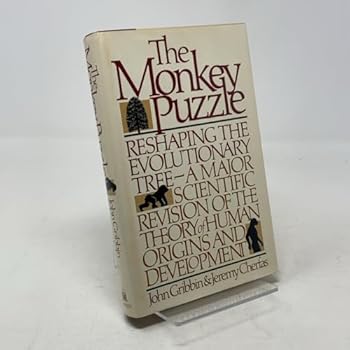
THE MONKEY PUZZLE: Reshaping The Evolutionary Tree

Select Format
Select Condition 
Book Overview
No Synopsis Available.
Format:Hardcover
Language:English
ISBN:0394527941
ISBN13:9780394527949
Release Date:January 1982
Publisher:pantheon 1982
Length:279 Pages
Weight:1.10 lbs.
Dimensions:1.6" x 5.5" x 7.9"
Customer Reviews
2 ratings
An adventure in molecular science
Published by Thriftbooks.com User , 23 years ago
The author of the previous review and I must have read a different book....I dont know where he got the 'ancient brain' idea. But, he is right that this is a wonderful book. I am sure genetics has advanced much since this book was written but I doubt that it's theories have been proven wrong. It is a well written, easy to read explaination of the molecular similarities between man, chimp and ape. And, using the molecular information, the authors propose an evolutionary tree that, to me, rings true.Read this book.
Ever wonder how humans got so brainy? The answer is here.
Published by Thriftbooks.com User , 26 years ago
This book is a classic. Try to locate one if you are interested in the brain. The puzzle of the title is this: DNA studies show we share 95% of our genome with chimps. How can such a slight difference in our respective genetic blueprints account for such a huge difference in skull and brain anatomy?This book proposes an explanation which, right or wrong, is just a splendid idea, a kind of intellectual marvel. The idea is that the brain is an ancient structure. It fully evolved over a period of many, many millions of years. This whole long evolutionary period is remote from us. It came and went a long, long time ago. In this scheme, the brain might, for example, have evolved within the head of an increasingly quick witted, deeply thoughtful, man-sized reptile. A big green one, let's say. In subsequent evolution the structure of the big brain was lost. It went silent, unexpressed. But it rode the genome down through the eons until suddenly, just 2 million years ago, it was re-expressed in apes. Ourselves. A biochemical accident. Today, chimps still carry the silent code for a big brain, just as they (and we) carry the silent code for many ancient structures like gills and flippers. Chimps don't express DNA encoding the big brain, but we do. If the hypothesis of an ancient big brain is accepted, a lot other problems suddenly solve themselves. The sudden, seemingly overnight appearance of the human brain, 2 million years ago, allows almost no time for such an elaborate structure to evolve. The answer: it didn't evolve 2 million years ago. It evolved long before, over a suitably long period of time, and simply re-appeared in man. Popped up fully realized. A current book, The Prehistory of the Mind, by Steven Mithen, an archaeologist, emphasizes a fascinating observation. Although the big brain appeared 2 million years ago, mankind did nothing particularly intelligent or impressive until 1.9 million years later, that is, just 100,000 years ago. Man was a toolmaker, yes, but he kept making the same oafish, primitive tool, a stone axe, consisting of a rock tied to a stick, for nineteen hundred thousand years. Finally, just 100K years ago, human beings suddenly got smart -he or more probably she -- finally found the boot disk. Everything, the whole explosion of human progress, has happened since that day. An explanation of the long night of the human brain, per Gribbin's Monkey Puzzle, would be genetic drift. Lack of maintenance. An ancient brain would have come down us in very poor operating condition. DNA encoding for any feature that is unused over time will lose fidelity like a fading photograph. So it took 1.9 million years to get the biochemistry of the brain to start working right once again. Finally, 100,000 years ago, it happened to kick in. And the rest is history. Find this wonderful book.
Copyright © 2026 Thriftbooks.com
Terms of Use | Privacy Policy | Do Not Sell/Share My Personal Information | Cookie Policy | Cookie Preferences | Accessibility Statement
ThriftBooks ® and the ThriftBooks ® logo are registered trademarks of Thrift Books Global, LLC
ThriftBooks ® and the ThriftBooks ® logo are registered trademarks of Thrift Books Global, LLC
