


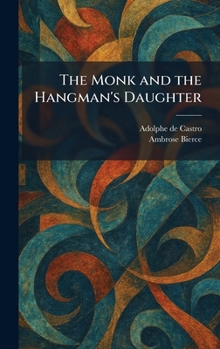
The Monk and the Hangman's Daughter

Select Format
Select Condition 
Book Overview
"The Monk and the Hangman's Daughter" is a haunting Gothic novella that explores the depths of religious devotion, social stigma, and psychological descent. Set against the stark, atmospheric backdrop of the late seventeenth-century Bavarian Alps, the narrative follows Ambrosius, a young and fervent monk sent to the remote monastery of Berchtesgaden. His life takes a fateful turn when he encounters Benedicta, the daughter of the local hangman-a girl shunned by society due to her father's grim profession.
Driven by a mixture of pious compassion and suppressed desire, Ambrosius attempts to save Benedicta's soul, only to find himself entangled in an increasingly obsessive and tragic struggle. As the monk's internal conflict intensifies, the story delves into themes of isolation, the thin line between holiness and madness, and the destructive power of unacknowledged passions. Collaboratively refined by Ambrose Bierce and Adolphe de Castro, "The Monk and the Hangman's Daughter" remains a powerful example of classic dark romanticism, offering a chilling meditation on morality and the human psyche.
This work has been selected by scholars as being culturally important, and is part of the knowledge base of civilization as we know it. This work was reproduced from the original artifact, and remains as true to the original work as possible. Therefore, you may see the original copyright references, library stamps (as most of these works have been housed in our most important libraries around the world), and other notations in the work.
This work is in the public domain in the United States of America, and possibly other nations. Within the United States, you may freely copy and distribute this work, as no entity (individual or corporate) has a copyright on the body of the work.
As a reproduction of a historical artifact, this work may contain missing or blurred pages, poor pictures, errant marks, etc. Scholars believe, and we concur, that this work is important enough to be preserved, reproduced, and made generally available to the public. We appreciate your support of the preservation process, and thank you for being an important part of keeping this knowledge alive and relevant.
Customer Reviews
ThriftBooks ® and the ThriftBooks ® logo are registered trademarks of Thrift Books Global, LLC
