


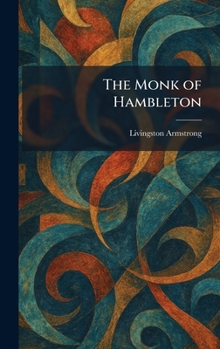
The Monk of Hambleton

"The Monk of Hambleton" is a classic mystery novel that explores the dark secrets hidden within a seemingly quiet community. When a shocking crime occurs, the peace of Hambleton is shattered, leading to a complex investigation where nothing is as it first appears. The narrative follows the intricate efforts to unmask a killer amidst a web of deception, local tensions, and long-held grudges.
Written by Armstrong Livingston, a notable figure in early twentieth-century detective fiction, the work is characterized by its atmospheric setting and its focus on deductive reasoning. The plot skillfully balances suspense with a detailed look at the social dynamics of the era, drawing readers into a world where every character has something to hide. As the title suggests, the enigmatic presence of the "monk" serves as a central point of intrigue, adding a layer of mystery to the procedural elements of the story.
Fans of traditional crime fiction and Golden Age mysteries will find "The Monk of Hambleton" to be a compelling example of the genre. Its focus on a localized, character-driven mystery showcases the literary craftsmanship that defined detective stories of the 1920s, offering a blend of tension and intellectual puzzle-solving that remains engaging for modern audiences.
This work has been selected by scholars as being culturally important, and is part of the knowledge base of civilization as we know it. This work was reproduced from the original artifact, and remains as true to the original work as possible. Therefore, you may see the original copyright references, library stamps (as most of these works have been housed in our most important libraries around the world), and other notations in the work.
This work is in the public domain in the United States of America, and possibly other nations. Within the United States, you may freely copy and distribute this work, as no entity (individual or corporate) has a copyright on the body of the work.
As a reproduction of a historical artifact, this work may contain missing or blurred pages, poor pictures, errant marks, etc. Scholars believe, and we concur, that this work is important enough to be preserved, reproduced, and made generally available to the public. We appreciate your support of the preservation process, and thank you for being an important part of keeping this knowledge alive and relevant.
Customer Reviews
ThriftBooks ® and the ThriftBooks ® logo are registered trademarks of Thrift Books Global, LLC
