


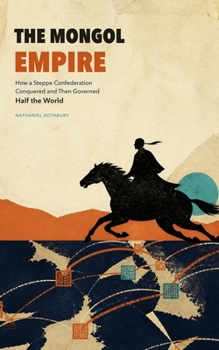
The Mongol Empire: How a Steppe Confederation Conquered and Then Governed Half the World

Mongol empire history rests on a striking imbalance: the largest contiguous land empire ever assembled left behind a thinner written record than many small kingdoms, and most of what survives was written by the people it conquered.
This book reconstructs the empire built by Chinggis Khan and his successors as a structure rather than a life story: the decimal army that doubled as a census, the relay system that could move a message across two thousand kilometers in a week, the succession procedure that eventually split the empire into four regional states, and the administrators, borrowed from Persia and China alike, who made governing possible without cities, bureaucracy, or a single written law of its own.
The book weighs the empire's undeniable violence against the unreliable numbers ancient chroniclers attached to it, and it traces the roads, taxes, and trade that connected the Mediterranean to the Pacific under Mongol rule, without treating either the conquest or the connectivity as the whole story.
Related Subjects
HistoryCustomer Reviews
ThriftBooks ® and the ThriftBooks ® logo are registered trademarks of Thrift Books Global, LLC
