


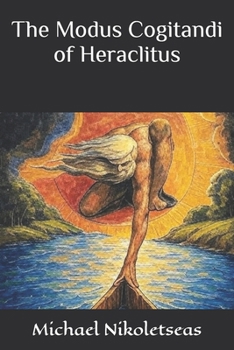
The Modus Cogitandi of Heraclitus
No Customer Reviews

Michael M. Nikoletseas' The Modus Cogitandi of Heraclitus (2015) offers a provocative reinterpretation of the pre-Socratic philosopher Heraclitus, challenging the long-standing perception of him as the "philosopher of flux." Through a lens grounded in natural science and epistemology, Nikoletseas argues that Heraclitus' primary contribution lies not in advocating a cosmology of constant change but in proposing a novel mode of thinking-a modus cogitandi-that transcends the limitations of natural language and dichotomous reasoning. This ambitious work seeks to reposition Heraclitus as a pioneer of scientific methodology, akin to his contemporary Parmenides, whose thought Nikoletseas explored in a prior book (Parmenides: The World as Modus Cogitandi, 2013). Nikoletseas' central thesis is compelling and well-supported: Heraclitus, far from celebrating flux, critiques the inadequacy of sense-derived natural language and advocates for a formal, structured system (logos) to represent the underlying permanence and lawfulness of nature. The author meticulously analyzes Heraclitus' fragments, drawing on translations (notably G.T.W. Patrick's) and the Greek text from Diels and Kranz (1903), to demonstrate that references to flux, opposites, and paradoxes are not endorsements but rhetorical devices to expose the flaws of common thinking. For example, Nikoletseas interprets Fragment 49a ("We step and do not step into the same rivers; we are and are not") not as a celebration of change but as a critique of nominalism and dichotomous thought, pointing to a deeper, stable reality accessible through a formal language. The book's natural science perspective is a refreshing departure from traditional philological or metaphysical readings. Nikoletseas draws parallels between Heraclitus' logos and modern scientific concepts like measurement, symmetry, and parsimony, suggesting that Heraclitus anticipated principles like Niels Bohr's complementarity (p. 17). This interdisciplinary approach bridges ancient philosophy and contemporary physics, making the text relevant to philosophers of science and physicists, as Nikoletseas himself hopes (p. 54). His comparison of Heraclitus' cyclical imagery (e.g., Fragment 36) to the permanence of natural laws, and even to virtual particles in quantum physics (p. 45), is particularly intriguing, though it occasionally stretches the evidence. Nikoletseas' emphasis on Heraclitus' epistemological concerns-his "struggle to verbalize intuitions of permanence" (p. 9)-is a significant contribution. By framing Heraclitus' work as an essay on method rather than cosmology, the author resolves alleged paradoxes (e.g., the unity of opposites) and dismisses the charge of obscurity. The detailed analysis of key fragments, such as Fragment 114 (on the "Law of Understanding" as a divine, universal principle) and Fragment 23 (logos as proportion or ratio), convincingly supports the idea that Heraclitus sought a precise, formal system for understanding physis (nature)
.
The book also highlights concordances with Parmenides, suggesting a shared intellectual milieu in the 6th-5th centuries BCE. Nikoletseas argues that both philosophers rejected binomial thinking and proposed formal systems (logos for Heraclitus, eon for Parmenides) to capture the world's underlying order (pp. 50-51). This comparative approach enriches the analysis, though the question of direct influence remains speculative, as the author acknowledges (p. 53). Recommended for philosophers of science, pre-Socratic scholars, and readers with an interest in epistemology and the history of scientific thought. Those new to Heraclitus may want to pair this with a more introductory text (e.g., Kahn's The Art and Thought of Heraclitus) for context.
.
The book also highlights concordances with Parmenides, suggesting a shared intellectual milieu in the 6th-5th centuries BCE. Nikoletseas argues that both philosophers rejected binomial thinking and proposed formal systems (logos for Heraclitus, eon for Parmenides) to capture the world's underlying order (pp. 50-51). This comparative approach enriches the analysis, though the question of direct influence remains speculative, as the author acknowledges (p. 53). Recommended for philosophers of science, pre-Socratic scholars, and readers with an interest in epistemology and the history of scientific thought. Those new to Heraclitus may want to pair this with a more introductory text (e.g., Kahn's The Art and Thought of Heraclitus) for context.
Format:Paperback
Language:English
ISBN:1515194116
ISBN13:9781515194118
Release Date:August 2015
Publisher:Createspace Independent Publishing Platform
Length:104 Pages
Weight:0.33 lbs.
Dimensions:0.2" x 6.0" x 9.0"
Related Subjects
PhilosophyCustomer Reviews
0 rating
Copyright © 2025 Thriftbooks.com
Terms of Use | Privacy Policy | Do Not Sell/Share My Personal Information | Cookie Policy | Cookie Preferences | Accessibility Statement
ThriftBooks ® and the ThriftBooks ® logo are registered trademarks of Thrift Books Global, LLC
ThriftBooks ® and the ThriftBooks ® logo are registered trademarks of Thrift Books Global, LLC
