


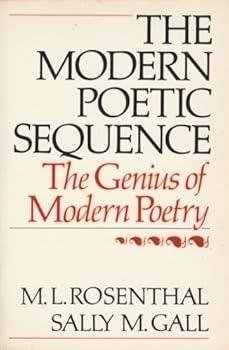
The Modern Poetic Sequence: The Genius of Modern Poetry

Select Format
Select Condition 
Book Overview
Ezra Pound's Cantos, T.S. Eliot's Waste Land, W.B. Yeat's Irish civil-war sequences, and William Carlos Williams's Paterson are some of the most genuinely creative poems of the present age--and all are examples of the modern poetic sequence. In this revolutionary critical study, Rosenthal and Gall establish the poetic sequence as the major genre of 20th-century poetry, claiming it as "the decisive form toward which all the developments of modern poetry have tended.
The Modern Poetic Sequence explores 125 years of poetic history and examines the works of some fifty poets--both major and minor--to describe the evolution of this moden poetic form. From Whitman and Dickinson to the Confessional poets Plath and Lowell to the recent writing of Kinsells, Montague, and Hill, this volume encompasses the entire development of the modern sequence and offers provocative insights not only into the boundaries and features of this particular genre, but into the whole of twentieth-century poetry. About the Author: M.L. Rosenthal is Professor of English at New York University.
Sally M. Gall is Poetry Editor of Free Inquiry.
The Modern Poetic Sequence explores 125 years of poetic history and examines the works of some fifty poets--both major and minor--to describe the evolution of this moden poetic form. From Whitman and Dickinson to the Confessional poets Plath and Lowell to the recent writing of Kinsells, Montague, and Hill, this volume encompasses the entire development of the modern sequence and offers provocative insights not only into the boundaries and features of this particular genre, but into the whole of twentieth-century poetry. About the Author: M.L. Rosenthal is Professor of English at New York University.
Sally M. Gall is Poetry Editor of Free Inquiry.
Format:Paperback
Language:English
ISBN:0195037340
ISBN13:9780195037340
Release Date:January 1986
Publisher:Oxford University Press
Length:522 Pages
Weight:1.02 lbs.
Dimensions:8.0" x 1.1" x 5.4"
Customer Reviews
1 rating
Poems in Groups and Why
Published by Thriftbooks.com User , 18 years ago
This is one of my favorite books of literary criticism of poetry. If you have ever wondered why and how poets group their poems into sets, this is the book for you. What makes a successful grouping? Which poets made successful groupings of poems and why do these sets work? This is a great book for poets who are wondering how to combine a pile of poems into a sequence. In music a piano sonata may have a first movement (sonata-allegro) a slow second movement, a minuet or scherzo third movement and a finale rondo or sonata-rondo. How do poets set up similar patterns in their work. What can a poem gain by its placement in a sequence? Why might a poet rearrange poems in a sequence? I find this book fascinating, and young poets would do well to take a look!
Copyright © 2026 Thriftbooks.com Terms of Use
| Privacy Policy | Do Not
Sell/Share My Personal Information | Cookie Policy | Cookie Preferences | Accessibility Statement
ThriftBooks® and the ThriftBooks® logo are registered trademarks of Thrift Books Global, LLC
ThriftBooks® and the ThriftBooks® logo are registered trademarks of Thrift Books Global, LLC
