


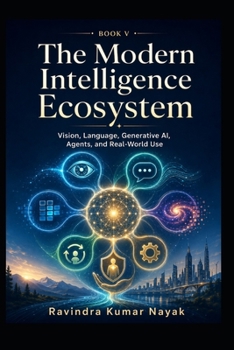
The Modern Intelligence Ecosystem
No Customer Reviews

Modern intelligence can feel overwhelming from the outside.
One day the conversation is about computer vision. The next day it is about language models, embeddings, transformers, generative systems, AI agents, retrieval, deployment, safety, bias, hallucinations, and responsible use. For non-technical readers, the words can arrive faster than understanding.
The Modern Intelligence Ecosystem was written to slow that world down.
This book is Book V in the Learning Deep Learning Slowly series, created for careful beginners, students, curious professionals, creators, educators, and future builders who want deep learning and modern AI to feel understandable before it feels powerful.
Instead of beginning with equations, code, or intimidating theory, this book begins with human questions:
What does it mean for a machine to see?
How do words become patterns a model can use?
Why do embeddings help systems compare meaning?
What problem did transformers help solve?
How does generative AI create text, images, ideas, or plans?
What makes an AI agent different from a chatbot?
Why do real-world systems need testing, monitoring, fallback, privacy, safety, and human responsibility?
Every technical idea is introduced only after the reader understands the problem that idea exists to solve.
Inside, the reader moves step by step through the modern intelligence ecosystem: computer vision, language models, tokens, embeddings, attention, transformers, generative AI, multimodal systems, agents, tools, memory, planning, retrieval, deployment, evaluation, guardrails, bias, hallucination risk, and responsible human use.
The style is intentionally calm, layered, and human.
There are dialogues for difficult ideas.
There are poetry pauses for reflection.
There are mind maps and visual anchors for memory.
There are practical questions for judging when AI is useful and when it needs caution.
There are no coding assumptions and no mathematical intimidation.
This is not a hype book.
It does not pretend modern intelligence is magic.
It does not promise shortcuts.
It teaches the reader how to organize the field from first principles.
By the end, readers will not only recognize modern AI terms. They will understand what those terms are doing. They will know how vision, language, generation, agents, deployment, safety, and responsibility connect inside one larger system.
For anyone who has heard the language of AI but wants a clear foundation before moving deeper, this book offers a slow, serious, beginner-friendly path from confusion to clarity.
One day the conversation is about computer vision. The next day it is about language models, embeddings, transformers, generative systems, AI agents, retrieval, deployment, safety, bias, hallucinations, and responsible use. For non-technical readers, the words can arrive faster than understanding.
The Modern Intelligence Ecosystem was written to slow that world down.
This book is Book V in the Learning Deep Learning Slowly series, created for careful beginners, students, curious professionals, creators, educators, and future builders who want deep learning and modern AI to feel understandable before it feels powerful.
Instead of beginning with equations, code, or intimidating theory, this book begins with human questions:
What does it mean for a machine to see?
How do words become patterns a model can use?
Why do embeddings help systems compare meaning?
What problem did transformers help solve?
How does generative AI create text, images, ideas, or plans?
What makes an AI agent different from a chatbot?
Why do real-world systems need testing, monitoring, fallback, privacy, safety, and human responsibility?
Every technical idea is introduced only after the reader understands the problem that idea exists to solve.
Inside, the reader moves step by step through the modern intelligence ecosystem: computer vision, language models, tokens, embeddings, attention, transformers, generative AI, multimodal systems, agents, tools, memory, planning, retrieval, deployment, evaluation, guardrails, bias, hallucination risk, and responsible human use.
The style is intentionally calm, layered, and human.
There are dialogues for difficult ideas.
There are poetry pauses for reflection.
There are mind maps and visual anchors for memory.
There are practical questions for judging when AI is useful and when it needs caution.
There are no coding assumptions and no mathematical intimidation.
This is not a hype book.
It does not pretend modern intelligence is magic.
It does not promise shortcuts.
It teaches the reader how to organize the field from first principles.
By the end, readers will not only recognize modern AI terms. They will understand what those terms are doing. They will know how vision, language, generation, agents, deployment, safety, and responsibility connect inside one larger system.
For anyone who has heard the language of AI but wants a clear foundation before moving deeper, this book offers a slow, serious, beginner-friendly path from confusion to clarity.
Format:Paperback
Language:English
ISBN:B0H7PQFC2Z
ISBN13:9798185678299
Release Date:July 2026
Publisher:Independently Published
Length:428 Pages
Weight:1.13 lbs.
Dimensions:1.1" x 6.0" x 9.0"
Customer Reviews
0 rating
Copyright © 2026 Thriftbooks.com
Terms of Use | Privacy Policy | Do Not Sell/Share My Personal Information | Cookie Policy | Cookie Preferences | Accessibility Statement
ThriftBooks ® and the ThriftBooks ® logo are registered trademarks of Thrift Books Global, LLC
ThriftBooks ® and the ThriftBooks ® logo are registered trademarks of Thrift Books Global, LLC
