


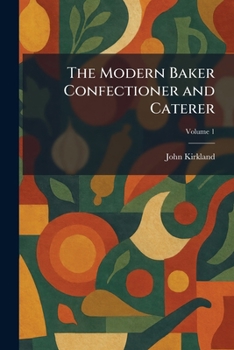
The Modern Baker Confectioner and Caterer

"The Modern Baker Confectioner and Caterer Divisional Vol. I" is an exhaustive and authoritative guide to the culinary arts of the early twentieth century. Authored by John Kirkland, this work provides a detailed exploration of the scientific principles and practical techniques required for professional baking, confectionery, and catering. This first volume delves into the fundamental aspects of the trade, offering professional insights into ingredients, equipment, and the precise chemistry involved in creating high-quality bread and flour goods.
Designed for both the aspiring professional and the established tradesperson, the text covers a vast array of topics, from the intricacies of yeast fermentation to the management of large-scale catering operations. The work stands as a significant historical record of the evolution of the baking industry, reflecting the transition towards modern industrial methods while maintaining a deep respect for traditional craftsmanship. Readers will find meticulously detailed instructions and observations that highlight the complexity of the baker's craft.
Whether approached as a practical manual or a window into culinary history, "The Modern Baker Confectioner and Caterer Divisional Vol. I" remains a vital resource for those interested in the heritage of baking and the professional standards of the early 1900s. It emphasizes precision, skill, and the artistic nature of the confectioner's work.
This work has been selected by scholars as being culturally important, and is part of the knowledge base of civilization as we know it. This work was reproduced from the original artifact, and remains as true to the original work as possible. Therefore, you may see the original copyright references, library stamps (as most of these works have been housed in our most important libraries around the world), and other notations in the work.
This work is in the public domain in the United States of America, and possibly other nations. Within the United States, you may freely copy and distribute this work, as no entity (individual or corporate) has a copyright on the body of the work.
As a reproduction of a historical artifact, this work may contain missing or blurred pages, poor pictures, errant marks, etc. Scholars believe, and we concur, that this work is important enough to be preserved, reproduced, and made generally available to the public. We appreciate your support of the preservation process, and thank you for being an important part of keeping this knowledge alive and relevant.
Customer Reviews
ThriftBooks ® and the ThriftBooks ® logo are registered trademarks of Thrift Books Global, LLC
