


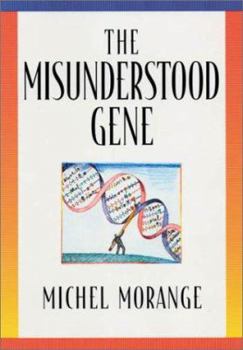
The Misunderstood Gene


Select Format
Select Condition 
Book Overview
At a time when the complete human genome has been sequenced and when seemingly every week feature news stories describe genes that may be responsible for personality, intelligence, even happiness, Michel Morange gives us a book that demystifies the power of modern genetics. This text takes us on an easily comprehensible tour of the most recent findings in molecular biology to show us how - and if - genes contribute to biological processes and complex human behaviors.
Format:Hardcover
Language:English
ISBN:0674003365
ISBN13:9780674003361
Release Date:June 2001
Publisher:Harvard University Press
Length:238 Pages
Weight:1.05 lbs.
Dimensions:8.5" x 0.8" x 5.8"
Customer Reviews
3 ratings
The Gene - A Modern Vision
Published by Thriftbooks.com User , 20 years ago
There is a good chance that you have seen this TV commercial: A three year old is knocking the socks off a highly ranked tennis professional. His parents, Andre Agassi and Steffi Graf, all-time tennis greats, pull up in a minivan beckoning the child to come home. The background voice says with finality: "The right genes make all the difference." Even if you missed the commercial, almost certainly you have read somewhere and recently: "A gene has been discovered for..." Alas, as has been said in a related context, "It ain't necessarily so." (Cf. R. Lewontin's It Ain't Necessarily So: The Dream of the Human Genome and Other Illusions, New York Review Books, 2000). Aptly titled, The Misunderstood Gene by Michel Morange provides a detailed account of the molecular processes that underlie human genetics. These details illustrate the mechanisms that make it unlikely we will find a gene for heart disease, diabetes, homosexuality or whatever, even in the midst of conventional wisdom that insists on the contrary and is burnished by the Mendelian-Crick view of genetic activity: ie. genes produce traits; beyond mutation, genes are hermetically sealed against environmental effects. (At this point, someone is sure to bring up single gene diseases in an au contraire tone of voice. From among many sources that might be cited, single gene disease proponents might want to read: Mulvihill, J.J. Craniofacial syndrome: No such thing as a single gene disease, Nature Genetics, 1995, 9, 101-103; Alper, J. Genetic complexity in single gene diseases. Brit. Med. J., 1996, 312, 196-197.). Morange, a molecular biologist and historian of science, is Professor of Biology and Director of the Center for the Study of the History of Science at the prestigious Ecole Normale Superieure in Paris. In 'Misunderstood' he follows up on his widely acclaimed A History of Molecular Biology (Harvard Univ. Press, 2000). After spending a lifetime of research in molecular biology and its history, lest he be misunderstood, Morange takes pains to make clear the fundamental role genes play in life processes. At the same time he aims to "put forward a new vision of genes" that will supersede the outmoded "concept of the gene that is used by the general public and by many scientists..." In this he succeeds admirably. The reader who expects the devil is in the details will not be surprised by Morange's account. However, those who want to learn more about non-genetic hereditary transmission will have to look elsewhere (for examples, cf. E. Jablonka & M.J. Lamb, Evolution in Four Dimensions, MIT Press, 2005; G. Gottlieb, Synthesizing Nature-Nurture, Lawrence Erlbaum, 1997). In Chapters One and Two, Morange reviews the classical concept of the gene, which as a salient obscured basic phenomena of developmental biology, and the ambiguities that compromise any simple rendering of the gene concept. Chapters Three and Five provide a brief description of how genes are studied including the "knockout" pr
an excellent read
Published by Thriftbooks.com User , 20 years ago
Morange's work does an excellent job clarifying the role that DNA has in life. To do this Morange gets into some history and even theology. He notes that theology has had a role in evolution from the very beginning of the theory. For example, Darwin "tried to remove God from the" natural world, even to the extent of opposing the idea of macrovariations (now called macroevolution) because he felt that this view had "an almost supernatural nature" (page 18). He supported gradualism until he died. In this case Darwin's atheistic theology got in the way of science progress. Now, due to the work of Gould and Elbridge, gradualism has fallen out of favor with many biologists. One of the goals of the book is to discuss the new view of evolution called Neutralism, a new theory of evolution that disputes several major aspects of neo-Darwinism. Neutralism emphasizes the role of chance in evolution and downplays that of natural selection (page 20). Morange notes that natural selection is now recognized as less important then it once was. He notes that "chance has began to assume an important place in evolutionary theory," partly because the work of biochemists has found the existence of "a large number of silent mutations that are not exposed to selection pressures" (page 19). The presence of a "particular form of gene in a given population is often due more to chance, or rather to history, than to pressure from natural selection" Morange then details this revolution in evolutionary biology. Will Neutralism replace neo-Darwinism? One thing is for sure genetics and the gene are far more complicated then we had ever dreamed even just a few years ago, and to adequately review this book would take another book. The last chapter is an excellent discussion of eugenics, an idea that is still, unfortunately, very much with us.
Misunderstanding the Misunderstood Gene
Published by Thriftbooks.com User , 24 years ago
First this is an excellent, clear and concise survey of recent breakthroughs in genetic microbiology. Don't hesitate to read this book because of anything I'm saying here. All the hullabaloo over the sequencing of the human genome (and others) is and was mere PR to get more funding and stock sales for the Genome Projects. As Morange points out, much of the hype has only confused the continuing issues of determinism and eugenics.But I couldn't help concluding that the writer spent too much time repeating the hype. The book is worth reading for the mouse and fuitfly knockout studies in themselves. How one missing gene and its offspring protein in the hypothalamus of a mother mouse dealt a death blow to her litter because it destroyed her insinct to nurse is an astonishing finding. Yet the Author treats it as a so-so event. In trying to complicate the process of gene determinism the Author, himself, seems to misunderstand the misunderstood gene. When a gene is singled out as producing one of many outcomes no one is trying to imply that the essential protein and cell organells do not play their important role in this outcome.For Morange to pretend he is adding great insight by pointing out that the human gene's protein is but one layer in a heirarchy of formational processes is quite redundant. Everyone knows the total matrix of the cell is essential to the expression of any gene.
Copyright © 2026 Thriftbooks.com Terms of Use
| Privacy Policy | Do Not
Sell/Share My Personal Information | Cookie Policy | Cookie Preferences | Accessibility Statement
ThriftBooks® and the ThriftBooks® logo are registered trademarks of Thrift Books Global, LLC
ThriftBooks® and the ThriftBooks® logo are registered trademarks of Thrift Books Global, LLC
