


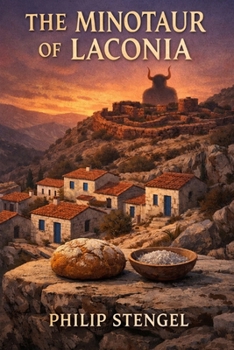
The Minotaur of Laconia

When historian Dr. Eleni Markou uncovers a fifteenth-century note about a hidden village in Laconia, she follows it into the Taygetos mountains searching for the truth her grandmother Nefeli spent a lifetime refusing to name. What she finds is not a dead legend, but a living system: a silent valley hidden behind a sunken road, a ruined settlement built like a bloodline maze, and a horned guardian the villagers do not worship so much as maintain. In this place, hospitality is contract, names can be thinned out of memory, and ancestry is not background. It is architecture.
As Eleni pushes deeper, the valley reveals its real logic. The labyrinth is not made of corridors but of kinship, debt, and inherited silence. Her grandmother did not merely leave this place. She fled it, tearing herself out of a sacrificial order that expected the women of her bloodline to serve as vessels for something ancient beneath the ruins. When Eleni's colleague Andreas Pappas arrives, his noise and ambition awaken the system further, and the village begins doing what it has always done best: absorbing disturbance, erasing witnesses, and rewriting the record until horror looks like custom.
What begins as archival investigation expands into multi-generational folkloric horror about inheritance, ritual enclosure, and the violence families rename as duty. By the novel's later movement, the burden shifts forward to a new generation, where another Nefeli and the man she loves stand at the center of the old design and discover that the guardian cannot simply be killed. It must be leashed, inherited, or released. The Minotaur of Laconia is psychological and mythic horror about bloodline obligation, sacred terror, and the nightmare of learning that the monster in the maze is also the structure that kept your family alive.
Customer Reviews
ThriftBooks ® and the ThriftBooks ® logo are registered trademarks of Thrift Books Global, LLC
