


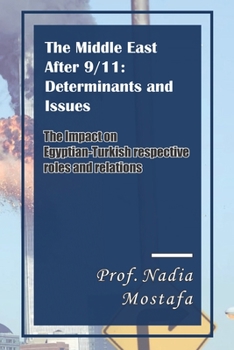
The Middle East After 9/11: Determinants and Issues: The Impact on Egyptian-Turkish respective roles and relations
No Customer Reviews

The term "Middle East" allows the inclusion of Turkey and other non-Arab countries- in addition to the Arab countries -into a wider system of regional interactions than that of the Arab system. The "Middle East" terminology started gaining increased attention than it did a century ago. Now, it is acquiring renewed attention after facing several setbacks along the 20th century. With the fall of the Ottoman Empire, the emergence of Ataturk's new regime in Turkey and Arab nationalism, conflicts between the Turks and the Arabs took place. A third party, The European Colonialism- under the auspices of mandate- was the beneficiary, while a complete blockage damaged Arab- Turkish relations. During the cold war, the gap between the Turkish and the Arab side was deepened with the creation of the state of Israel and the radical Arab nationalists' orientations and policies. The last quarter of the 20th century witnessed the reconstruction of bridges and a relaxation in the Turkish- Arab relations. Since 1991 a Turkish initiative towards the Arab world -which was met by a positive Arab response- started and deepened relations. The end of the cold war, the consequences of the Gulf crisis and the launching of the Madrid peace process affected the relations between both sides.By the end of the 20th century and in the light of the experiences of the evolution of Arab- Turkish relations, we can conclude that foreign influences and interventions that had consequently reshaped the regional context have had a major impact on Arab- Turkish relations and on the reciprocal perspectives and positions towards regional issues. The Ottoman Empire history- whether the periods of strength or weakness- provided us with memories of historical experiences which proved that foreign interventions had negatively affected the Arab-Turkish relations.Our actual interest in the "Middle East after 9/11" is an interest in a new critical period where the region is facing a serious reshaping process imposed by the American Power and its Allies. Hence, major foreign intervention is radically affecting regional balances and internal systems. So, the launching of the American initiative for a "Greater Middle East" is considered, after the occupation of Afghanistan and Iraq, as the third step in applying the global American strategy after 9/11. Accordingly, determining the nature of the Egyptian and the Turkish positions towards such a Middle Eastern context that the US is planning for, will be the main concern of this paper.
Format:Paperback
Language:English
ISBN:B085RTHS3S
ISBN13:9798627175041
Release Date:March 2020
Publisher:Independently Published
Length:30 Pages
Weight:0.13 lbs.
Dimensions:0.1" x 6.0" x 9.0"
Customer Reviews
0 rating
Copyright © 2026 Thriftbooks.com Terms of Use
| Privacy Policy | Do Not
Sell/Share My Personal Information | Cookie Policy | Cookie Preferences | Accessibility Statement
ThriftBooks® and the ThriftBooks® logo are registered trademarks of Thrift Books Global, LLC
ThriftBooks® and the ThriftBooks® logo are registered trademarks of Thrift Books Global, LLC
