


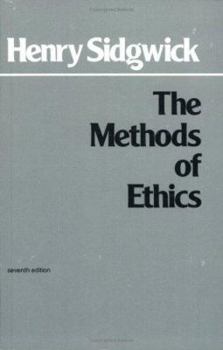
The Methods of Ethics, 7th Edition

Select Format
Select Condition 
Book Overview
This work has been selected by scholars as being culturally important, and is part of the knowledge base of civilization as we know it.This work is in the "public domain in the United States of... This description may be from another edition of this product.
Format:Paperback
Language:English
ISBN:0915145286
ISBN13:9780915145287
Release Date:August 1981
Publisher:Hackett Publishing Company
Length:568 Pages
Weight:1.65 lbs.
Dimensions:9.0" x 1.3" x 6.0"
Customer Reviews
2 ratings
A Philosophy Classic
Published by Thriftbooks.com User , 17 years ago
Along with Adam Smith's Theory of Moral Sentiments and Herbert Spencer's Principles of Ethics, this treatise is one of the great under-read masterpieces of British moral philosophy. The book reflects both wide learning and careful study. Sidgwick casts a broad net, and pulls in some very fish. The three "methods of ethics" he explores are, basically, egoism, intuitionism, and utilitarianism. Though his arguments ultimately fail to convince me of what he is trying to convince me, they are amazingly fecund. You will not stop thinking about this book after you have read it. The highlight of the book, for me, I'm afraid, was his brilliant few pages criticizing libertarianism in social ethics. This is probably the first such critique that stays on point, and is worth careful study by all who place primacy on liberty.
A Key Text in the History of Ethics
Published by Thriftbooks.com User , 21 years ago
The Methods of Ethics is Sidgwick's great systematic treatise on ethics. It's also a central text in the history of philosophy, and it can be understood as the work that initiated contemporary ethical theory in the English-speaking world. Of course, this isn't a work that came out of nowhere. In fact, it's informed by Sidgwick's firm grounding in the history of previous ethical thought. And unlike many great philosophers, what Sidgwick has to say about his intellectual forbears is usually reasonably accurate. (See his Outlines of the History of Ethics for additional evidence of his knowledge--and for an excellent introduction to the history of ethics.)This book is long; it's detailed; and it aspires to comprehensiveness. Indeed, all of the main areas of philosophical ethics (viz. meta-ethics, normative ethics, and moral psychology) are covered herein. Consequently, it's simply impossible to summarize Sidgwick's argument here. Instead of futilely attempting to do so, I'll simply provide the barest outline of Sidgwick's aims and his results. According to Sidgwick, there are three fundamental methods of ethics: egoistic hedonism, intuitionism, utilitarianism. He wants to examine the nature and plausiblity of each of these methods. The fundamental principle of egoistic hedonism is that what one ought to do (i.e. what one has most reason to do) is what will maximize one's own net amount of pleasure in the long run. The method of hedonism is the method of determing what one ought to do by accumulating empirical evidence about the consequences of particular actions for one's own happiness. Intuitionism, according to Sidgwick, is the view that we have an ability to discern the rightness and wrongness of actions without drawing on empirical evidence concerning the consequences of those actions. The intuitionist tells us that certain fundamental moral principles are self-evident to all who understand them. And intuitionism, Sidgwick claims, is the method underlying common-sense morality. Finally, the fundamental principle of utilitarianism is that what we ought to do is what will maximize the net amount of pleasure for all sentient beings. Perhaps the most important conclusion of Sidgwick's book is that the method of intuitionism is swallowed up by utilitarianism. For utilitarianism allows us to explain all the elements of the morality of common sense, elements that Sidgwick discusses at length in his account of intuitionism; and furthermore, the self-evident moral principles at which a reflective intuitionism allows us to arrive are principles from which we can prove the fundamental principle of utilitarianism. This, Sidgwick thinks, eliminates any apparent conflict between these two methods, and it shows that utilitarianism, when properly understood, is consistent with common-sense morality.But Sidgwick thinks that the relation between utilitarianism and egoistic hedonism remains problematic. The final conclusion of his book is that
Copyright © 2026 Thriftbooks.com Terms of Use
| Privacy Policy | Do Not
Sell/Share My Personal Information | Cookie Policy | Cookie Preferences | Accessibility Statement
ThriftBooks® and the ThriftBooks® logo are registered trademarks of Thrift Books Global, LLC
ThriftBooks® and the ThriftBooks® logo are registered trademarks of Thrift Books Global, LLC
